
A business plan is typically a lengthy document, while the BMC provides a concise overview.
The focus of a business plan is on detailed strategies and financial projections, while the BMC focuses on the core components of a business model.
Business plans are often used for traditional funding purposes, while the BMC is useful for brainstorming, validating, and communicating a business model idea.
The BMC was developed by Alexander Osterwalder as a part of his Ph.D. research in 2004.
It has gained significant popularity among entrepreneurs and business professionals as a practical tool for designing and refining business models.
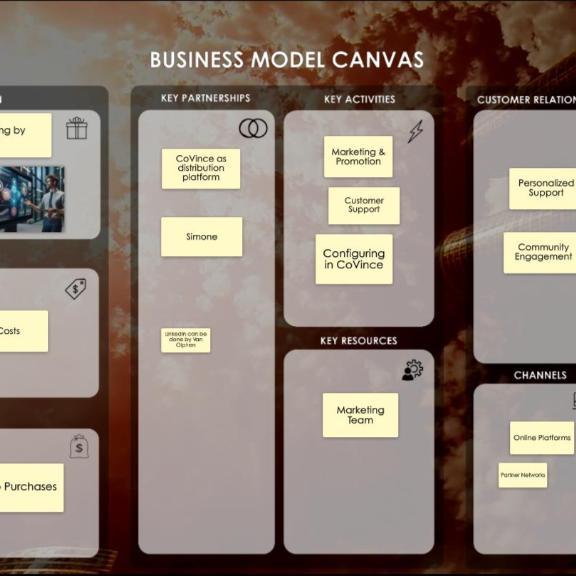
The BMC consists of nine key building blocks: customer segments, value propositions, channels, customer relationships, revenue streams, key resources, key activities, key partnerships, and cost structure.
Visualization: The BMC provides a visual representation of a business model, making it easier to understand and communicate.
Simplification: By breaking down a complex model into key components, the BMC simplifies the process of analyzing and improving a business model.
Flexibility: The BMC allows for iterative changes and adjustments, making it suitable for startups and businesses in dynamic environments.
Collaboration: The visual nature of the BMC makes it conducive to collaborative discussions, fostering input and insights from various stakeholders.
The BMC provides a holistic view of a business model, allowing entrepreneurs to consider all aspects simultaneously.
The BMC is an iterative tool, meaning that it can be updated and adjusted as the business evolves or new insights emerge.
The BMC emphasizes the importance of customer-centric thinking and identifying unique value propositions to attract and retain customers.
The BMC has been translated into multiple languages and used by millions of entrepreneurs worldwide.
It has become a popular tool in business education programs and workshops, facilitating discussions and collaborations among participants.
The BMC can be used alongside a traditional business plan to provide a more comprehensive understanding of a business model and its strategic implications.