Practise a conversation with an avatar
An Avatar Chat slide puts a talking avatar inside a learning. The reader speaks or types, the avatar answers in character, and at the end the reader gets feedback against the goal you set - a safe place to practise an intake, a difficult talk or a complaint.
Competence - practise a conversation - 7 min. You need: a learning you may change
Nothing happens until you press Save. You can try it all and press Cancel.
What you will be able to do
- Add a talking avatar One slide in your learning becomes a conversation.
- Say what the talk is for Who the avatar plays, and what your reader must learn.
- Pick a face and a voice A ready-made 3D face, or your own photo.
- Try it yourself Talk to it once before anyone else does.
Get this ready first
- A learning No learning yet? The explainer "Make a learning" shows how.
- One conversation to practise For example: the first talk with a new client.
Do it together, one step at a time
Seven steps. The pictures are the real screens.
Open your learning
Open the learning where the talk belongs.
- Open the learning. How to get there is in the explainer Make a learning .
- On the left is the FLOW TREE : the blocks of your learning, each with its slides.
- Click the block where the conversation goes, for example Client intake - practice .
- Top right is the green Add Slide button. That is the next step.
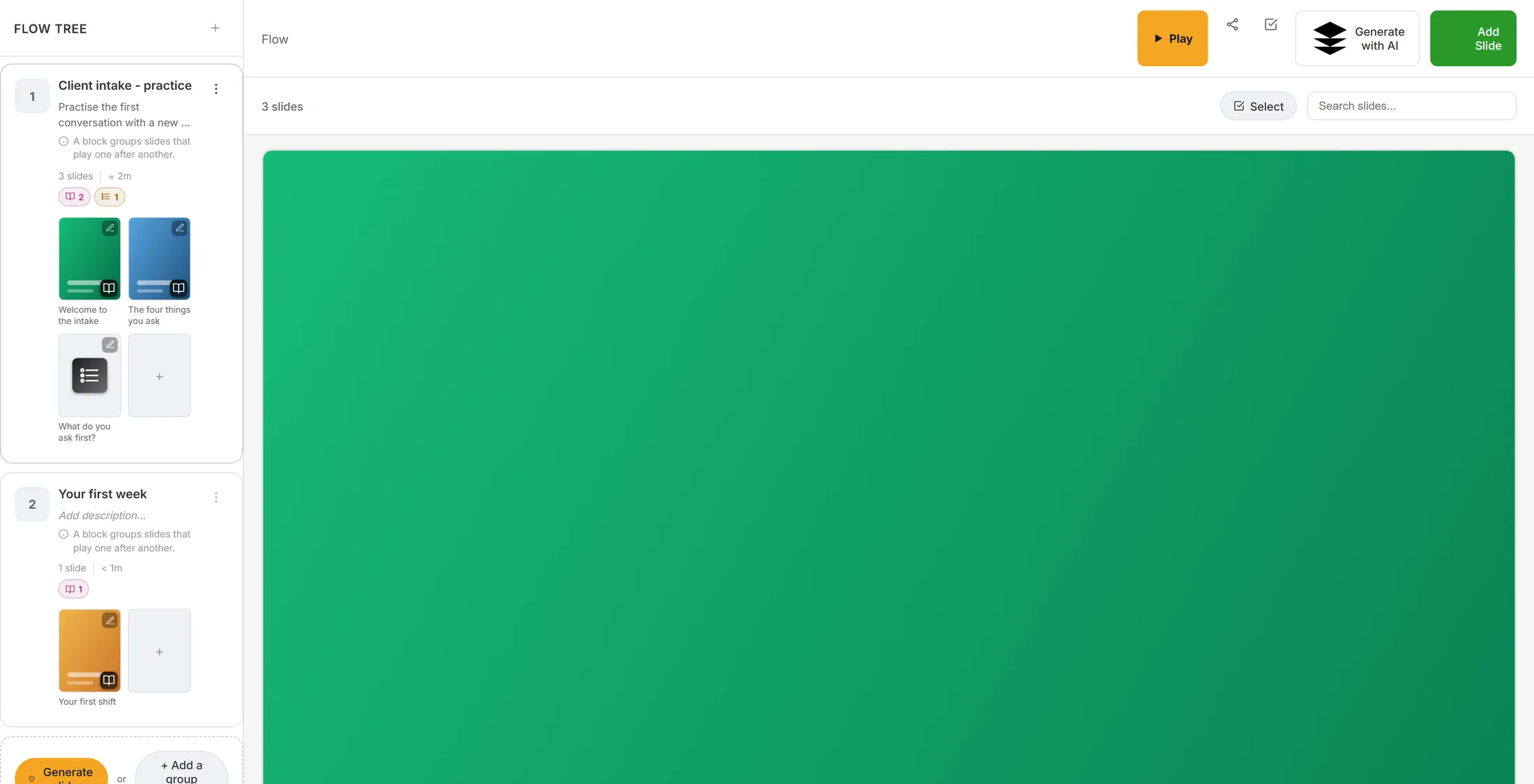
Your learning. The blocks are on the left. Add the Avatar Chat slide
Pick the kind of slide with the talking face.
- Press Add Slide. The window Select Slide Type opens.
- Type conversation in the search box at the top.
- Under AI you now see two cards. Avatar Chat - Role-play with a talking avatar . That is the one.
- AI Conversation is the lighter one: a text chat with an AI study buddy about the lesson, no face and no voice.
- Click Avatar Chat. The slide is added and its panel opens on the right.
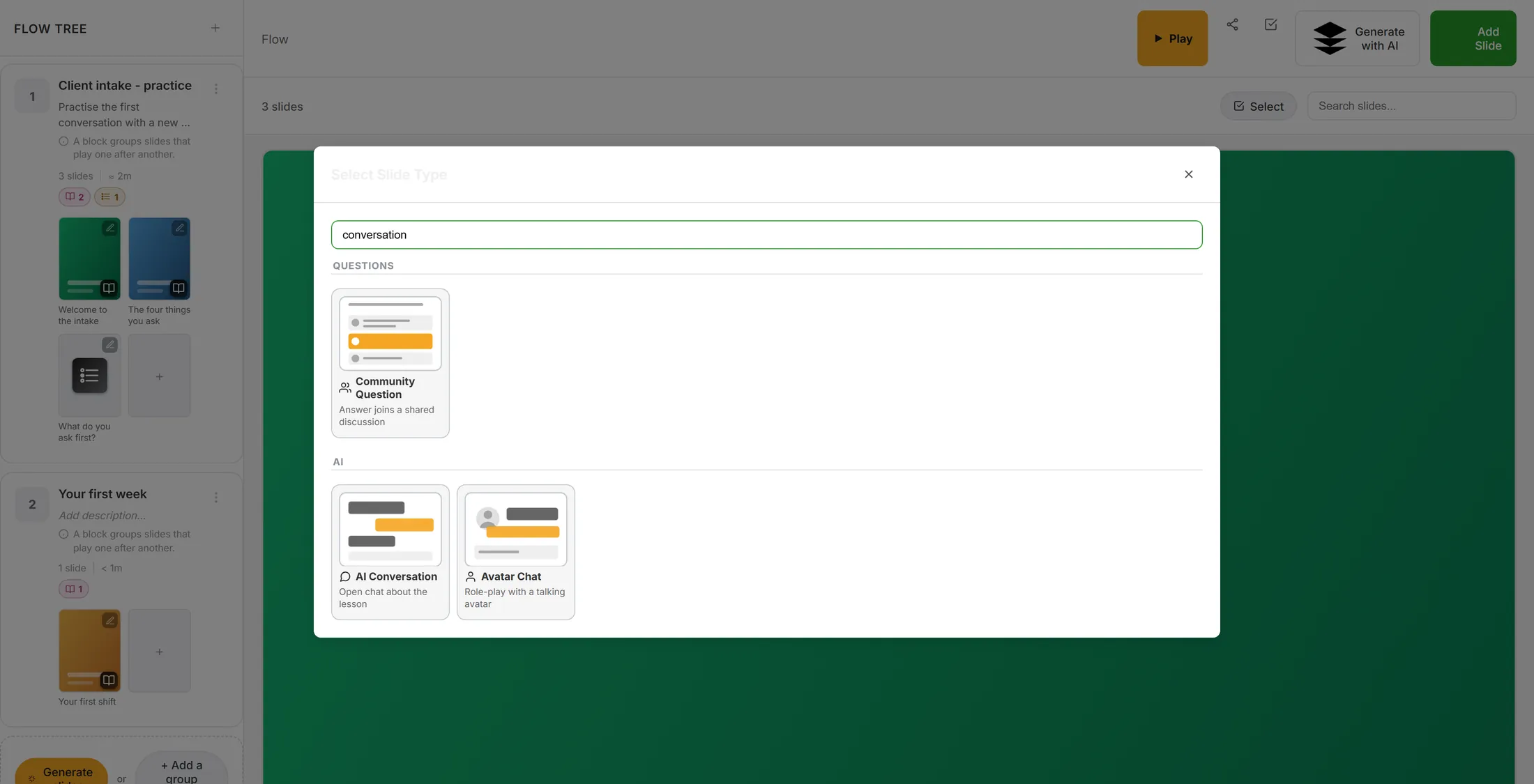
Search "conversation". Avatar Chat is the card with the face. Open the conversation settings
The slide has one big button. It opens everything.
- The panel on the right says Avatar Chat at the top. Your new slide is in the list on the left.
- Give it a TITLE , for example Practise: the intake conversation .
- Press the orange Edit avatar conversation button. Under it: Persona, avatar, voice, opening message, AI context and limits.
- The window Avatar conversation opens.
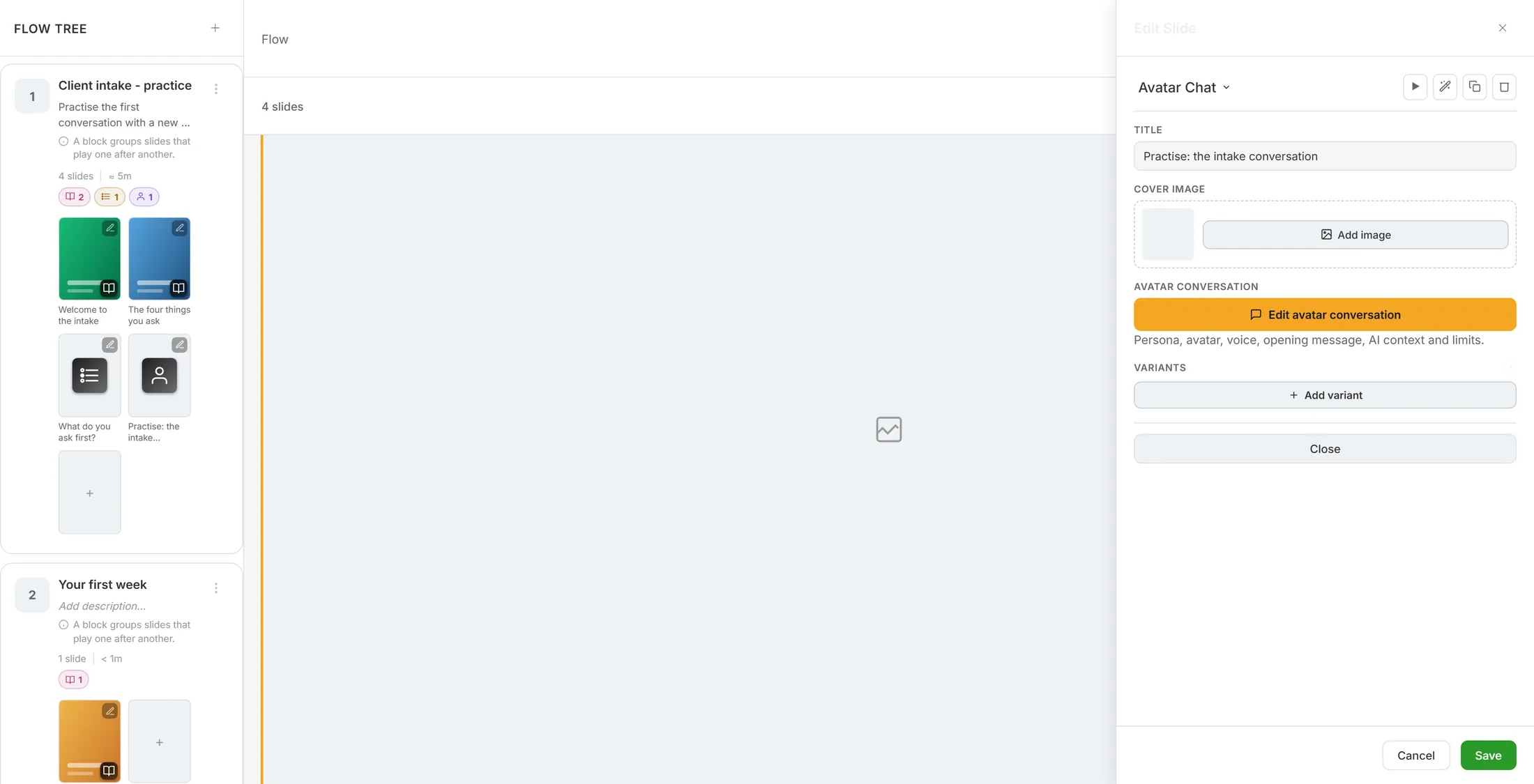
One button opens the conversation. Say who it is and what it is for
Tell the avatar its role, and tell it what your reader must learn.
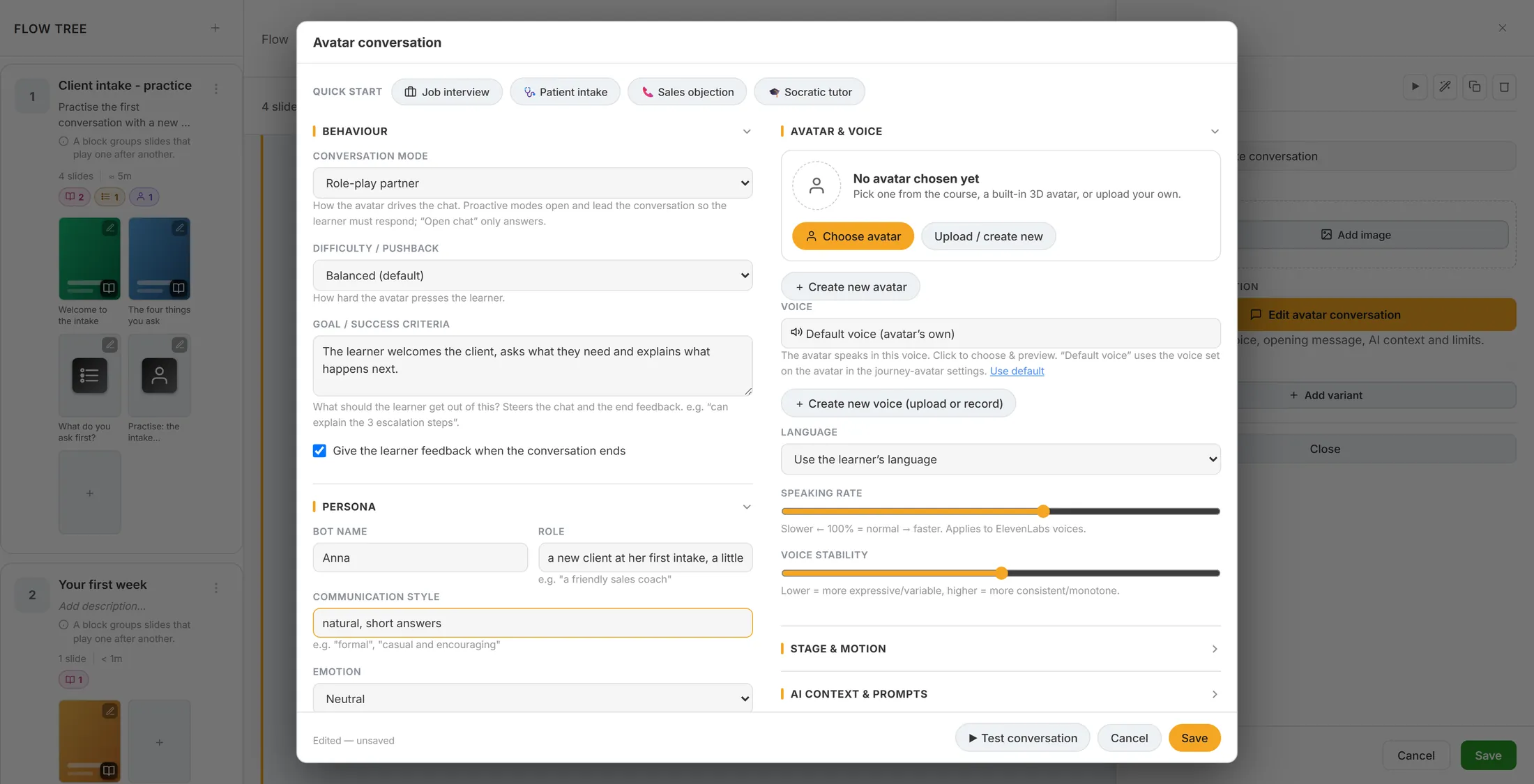
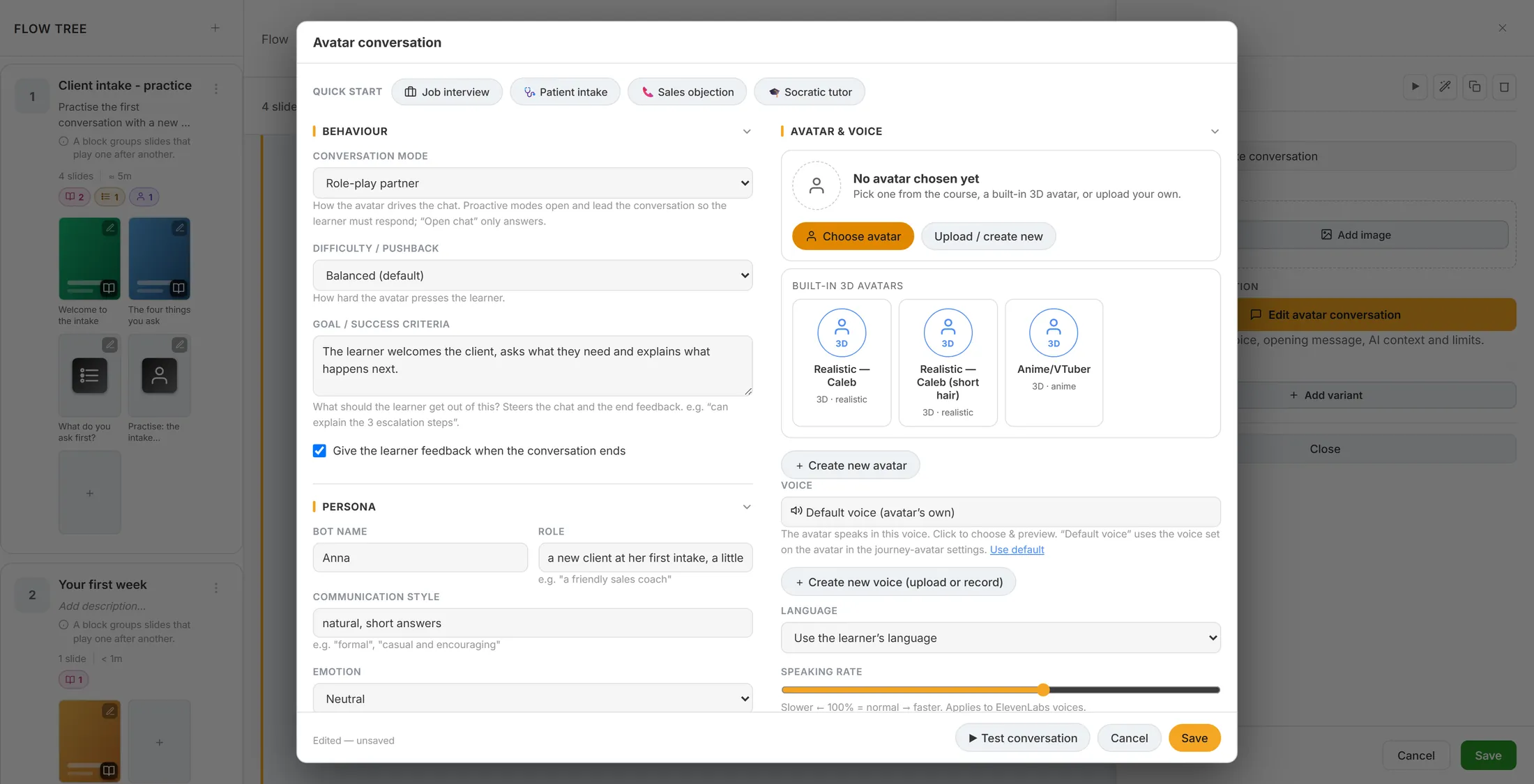
- Quickest start: press one of the QUICK START buttons - Job interview, Patient intake, Sales objection or Socratic tutor. It fills everything in; you change what does not fit.
- Conversation mode : how the avatar leads. Role-play partner for practising a talk. The others: Open chat, Pose a dilemma, Q&A buddy, Socratic coach, Devil's advocate.
- Difficulty / pushback : Gentle, Balanced or Challenging.
- Goal / success criteria : what the reader must do, in one sentence. The avatar steers towards it. Example: The learner welcomes the client, asks what they need and explains what happens next.
- Tick Give the learner feedback when the conversation ends - then the reader hears how they did against that goal.
- Persona : a Bot name ( Anna ), a Role ( a new client at her first intake, a little worried ), a Communication style and an Emotion .
The goal and the role, filled in. Pick a face and a voice
Choose how the avatar looks and sounds.
- The card says No avatar chosen yet . Press Choose avatar.
- You see the avatars of this course (if there are any) and the BUILT-IN 3D AVATARS . Click one. It is added to the course at once and chosen.
- Your own? Press Upload / create new: a photo for a talking face, or a 3D model (.vrm or .glb), a name and a voice.
- Voice : press it to hear and choose one. Default voice uses the avatar's own voice.
- Language : Use the learner's language is the usual choice.
Ready-made faces, or your own. The first sentence, the length, then Save
Say how it starts and how long it lasts. Then save and try it.
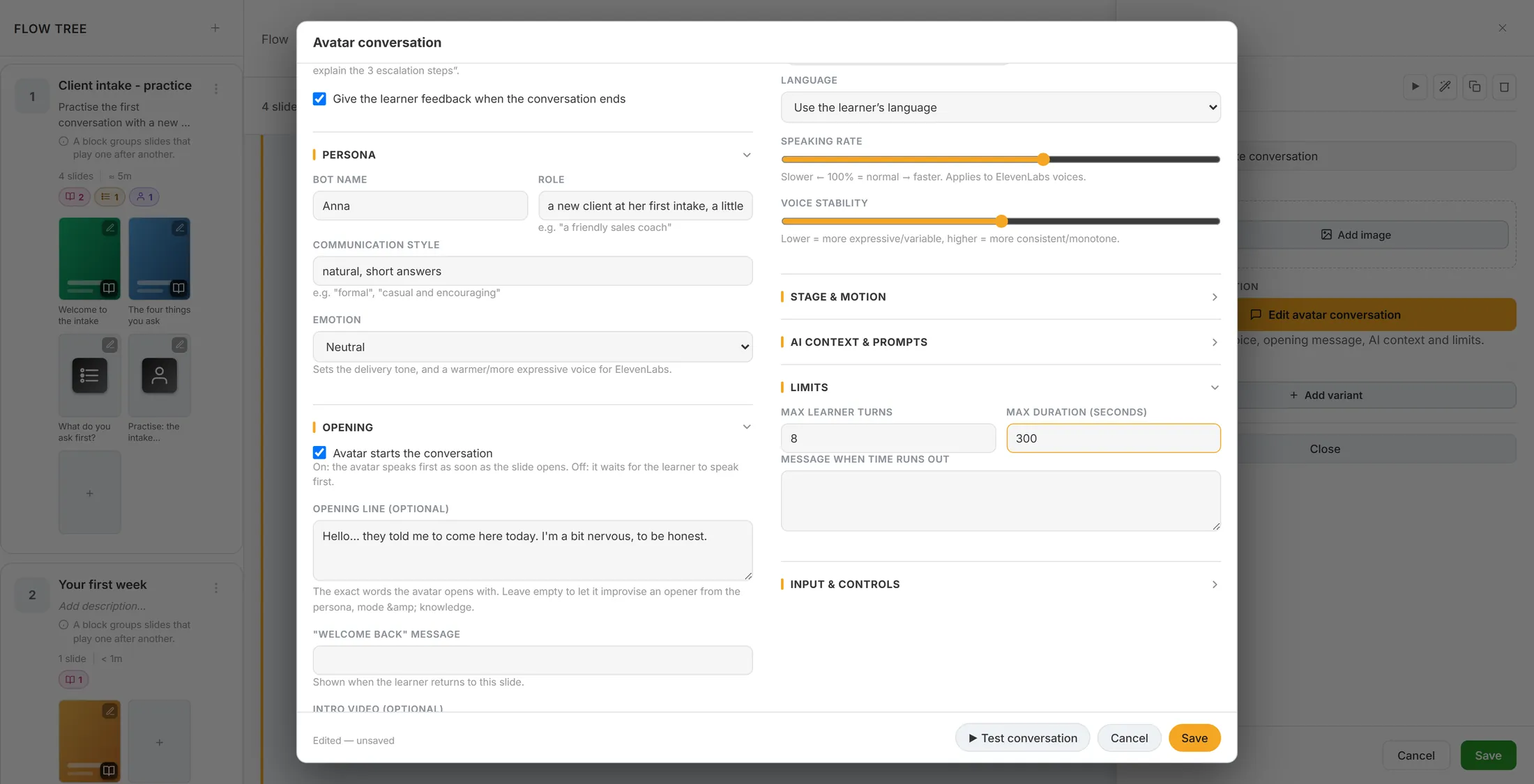
- Opening : leave Avatar starts the conversation ticked - it speaks first. Type its first words in Opening line , or leave it empty and it makes one up.
- Limits (press the word to open it): Max learner turns , for example 8, and Max duration (seconds) , for example 300.
- When a limit is reached the conversation ends, and only then does the reader get the arrow to the next slide.
- Input & controls has more: text only (no microphone), mail the transcript, scroll back through the chat.
- Press Save. Until then the line bottom left says Edited - unsaved .
- Press Test conversation to save and talk to it yourself in the player.
How it starts, how long it lasts, and Save. What your reader sees
A face that talks, a button to speak, and a box to type.
- The avatar appears and says its opening line out loud.
- The reader presses the microphone and talks, or types in the box.
- The avatar answers as the person you described - Anna, a little worried.
- A counter shows how many turns are left.
- When the talk ends, the reader gets the feedback (if you ticked it) and the arrow to go on.
If something is not right
There is no Avatar Chat card.
Type "avatar" in the search box. Still not there? Ask the person who looks after CoVince where you work.
My reader cannot go on.
The arrow comes when the talk ends. Set a number of turns or seconds.
My changes are gone.
Press Save in the window before you close it.
Does it give points?
No. It gives feedback at the end.
The words, in plain language
- avatar
- A face on the screen that talks and listens.
- role-play
- Practising a talk, with someone playing the other person.
- persona
- Who the avatar pretends to be.
Where to go next
- Make a learning Start here if you have no learning yet.
- A story with a choice Let your reader choose what happens next.
- All explainers The other things you can learn here.