
Obeya in education: a smaller wall for teams and projects
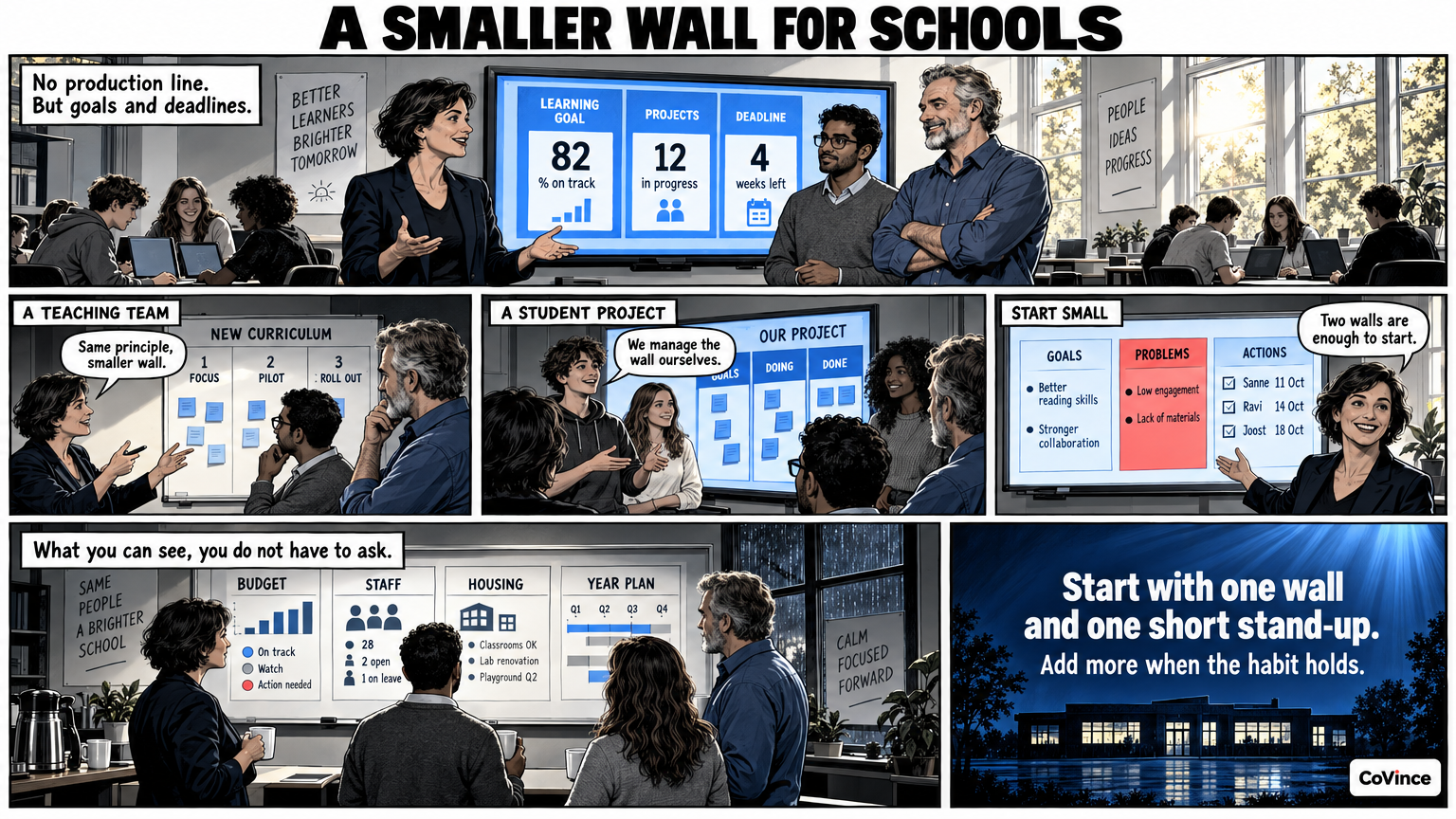
An Obeya in education is smaller in scale than in a factory or hospital: one wall for a team, a course or a project, with goals, planning and actions. It fits well with learning in a journey, where teachers and students work in the same place. You start with one wall and one short stand-up.
Where an Obeya fits in education
A school or course has no production line, but it does have goals, deadlines and a team that has to coordinate. A few places where a wall works:
- A teaching team or department preparing a new curriculum, an inspection or a renovation.
- A course with several teachers and placement supervisors who watch the same students.
- A student project, such as a project group or a minor, where the students manage the wall themselves and present the result.
- A school leadership following the year’s plans: goals, budget, staff and housing.
It is the same principle as everywhere: what you can see, you do not have to ask. The state of affairs hangs there, for everyone.
Start small
In education the chance is high that a full Obeya with four walls feels too heavy. It does not have to be. Start with one of these two:
- Goals and KPIs: three to five numbers the team wants to follow together, for example the number of assignments handed in, attendance or the progress of a project. Every measurement with a target and a colour.
- Problems and actions: a list of what is not going well, with an action, an owner and a date per problem.
Add plan and milestones as soon as the habit is in place, and decisions and risks last. More on the order in The five Obeya walls.
Learning in a journey
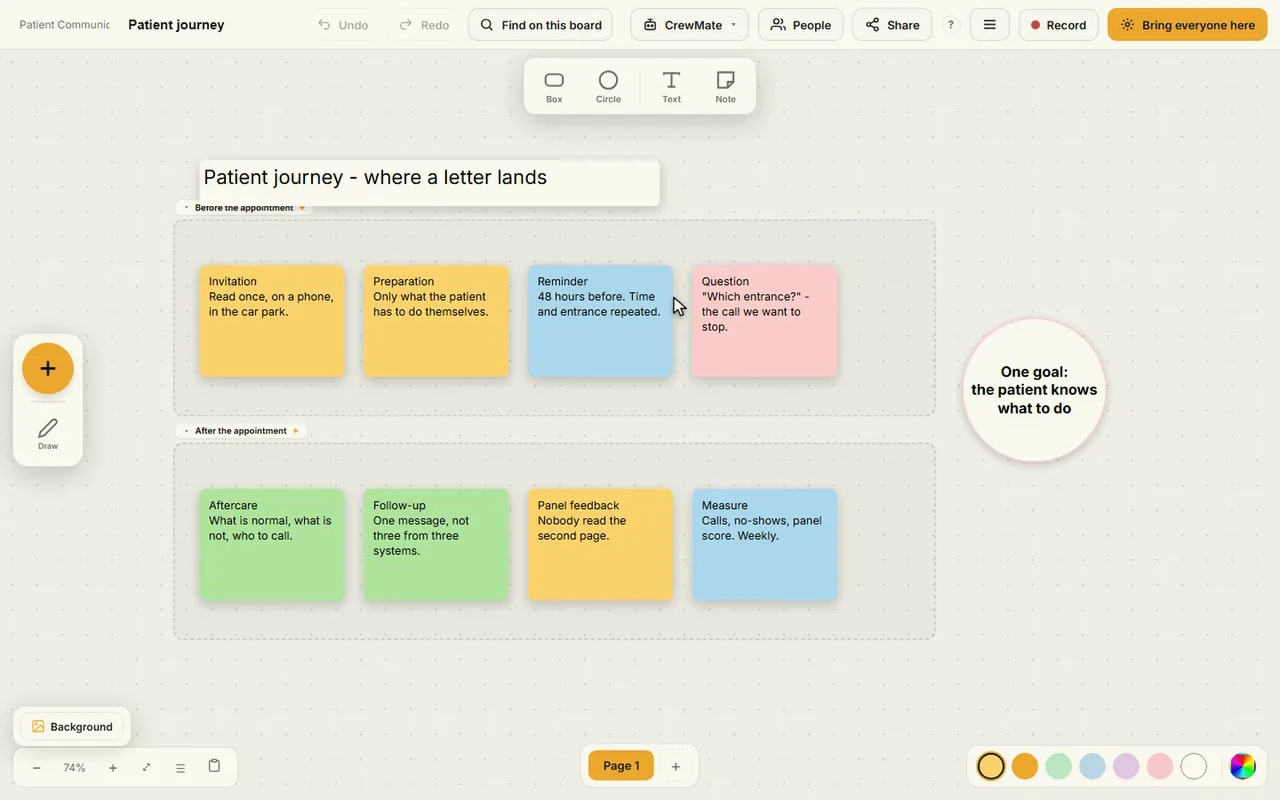
CoVince works with journeys: a place where the work of a team or a group comes together. An Obeya fits in naturally. The board, the actions, the conversations and the documents are in the same journey, so a student or teacher does not have to search for where something is.
- Canvas: an infinite board with sticky notes, shapes, arrows and charts, suited to a problem analysis or a planning that students make together.
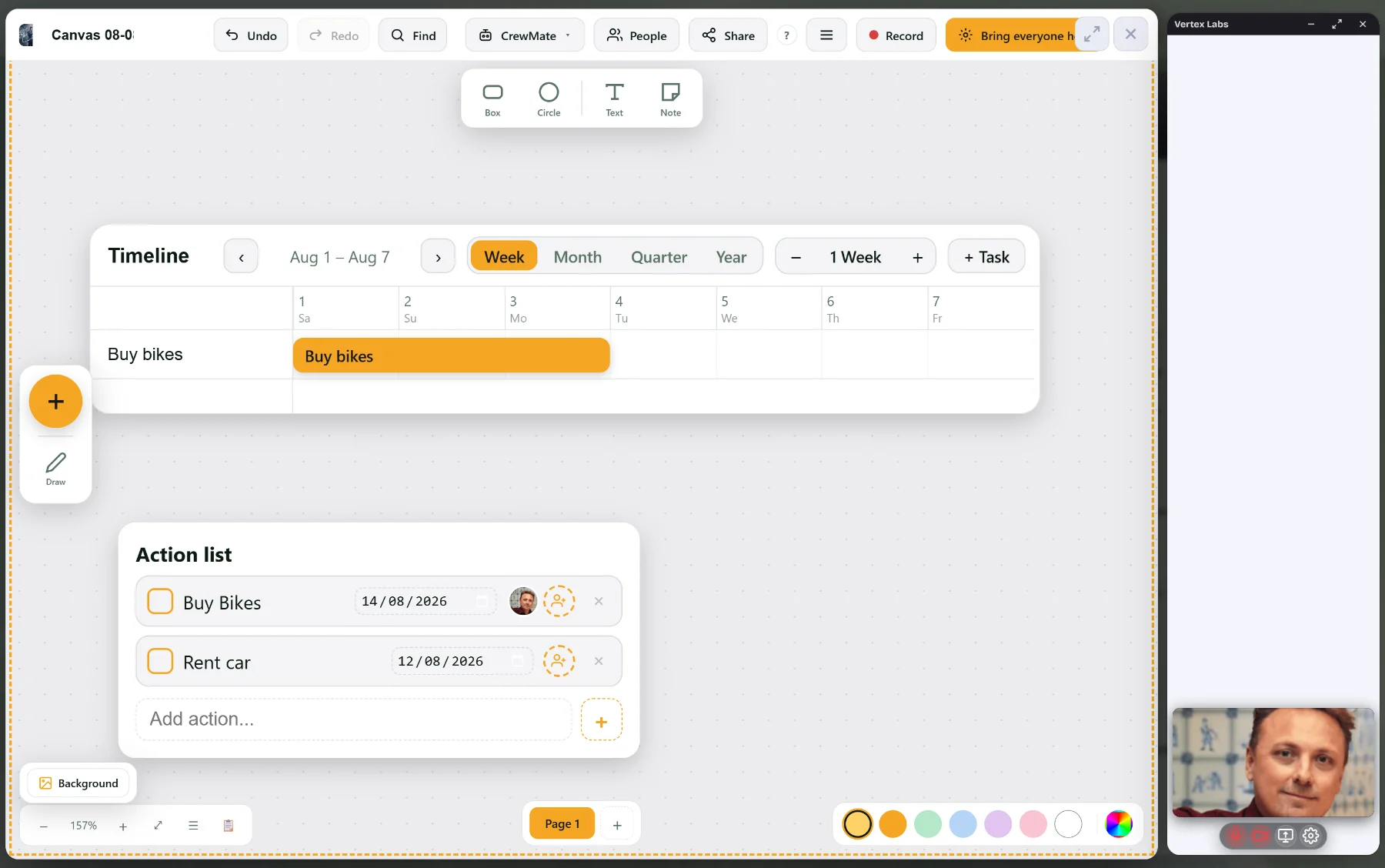
- Actions and timeline: every action an owner and a date, visible on the board and on the timeline, until it is done.
- Docs and grids: documents and spreadsheets you edit together, next to the board.
- Video calling: in CoVince itself, for whoever is not in the room. Guests, such as an external supervisor, join without an account.
A short stand-up, with students too
The core is a short rhythm. For a team of teachers that is for example fifteen minutes a week in front of the wall. For a student project it is a short stand-up per day or per lesson.
- What is red? Which task is behind, which deadline is coming?
- Who picks it up? Every action gets a name and a date.
- What have we learned? One sentence about what can be better, and that becomes the next action.
That is the PDCA principle in miniature: plan, do, check, act. For students it is also a way to practise collaborating and taking responsibility. The agenda in detail is in Obeya stand-up: agenda and rhythm.
A CrewMate as help
A CrewMate is an AI colleague that knows the journey and the board. It answers questions about what is on the board, out loud too, and makes a proposal for a plan with owners and dates. It proposes and you decide what goes on the wall. For a teacher that can make the first board faster, and for students a starting point to respond to.
What to watch for
- Student data: do not put personal data on a shared wall. Numbers about a group are safer than numbers about a person. Agree with your own organisation what is allowed.
- Keep it small. Three numbers everyone knows are better than twenty nobody maintains.
- The wall belongs to the team. Let teachers or students update it themselves, otherwise it becomes a report for someone else again.
A first week
You do not need a separate room. A digital Obeya works on a laptop or one big screen in the classroom. Make a journey, put three numbers and an action list on it, and hold a five-minute stand-up every day in the first week. After that you know what the team needs.
Three things that often go wrong in education
The wall belongs to the teacher, not to the team or the students. Then one person maintains it and it stops when that person is busy. Divide the roles: someone leads, someone manages, and those roles rotate.
There is no fixed moment. A wall without a rhythm is a notice board. Choose a fixed moment per week or per lesson and stick to it, even if it is short.
The wall shows people instead of progress. Keep numbers about groups and projects, and leave personal data of students off a shared wall.
Frequently asked questions
Is an Obeya not too heavy for a school?
It does not have to be. Start with one wall, for example goals and KPIs or problems and actions, and one short stand-up. Add the rest later.
Can students maintain the wall themselves?
Yes, and that works best. Every action has an owner and a date, and the team updates its own status.
What is the connection with learning in a journey?
In CoVince the board, the actions, the conversations and the documents are in the same journey, so teachers and students work in one place.
May student data go on the wall?
Rather put numbers about a group than about a person on a shared wall. Agree with your own organisation what is allowed.
Do we need special screens?
No. A laptop or one big screen in the classroom is enough.