
The five Obeya walls: goals, KPIs, plan, problems and actions
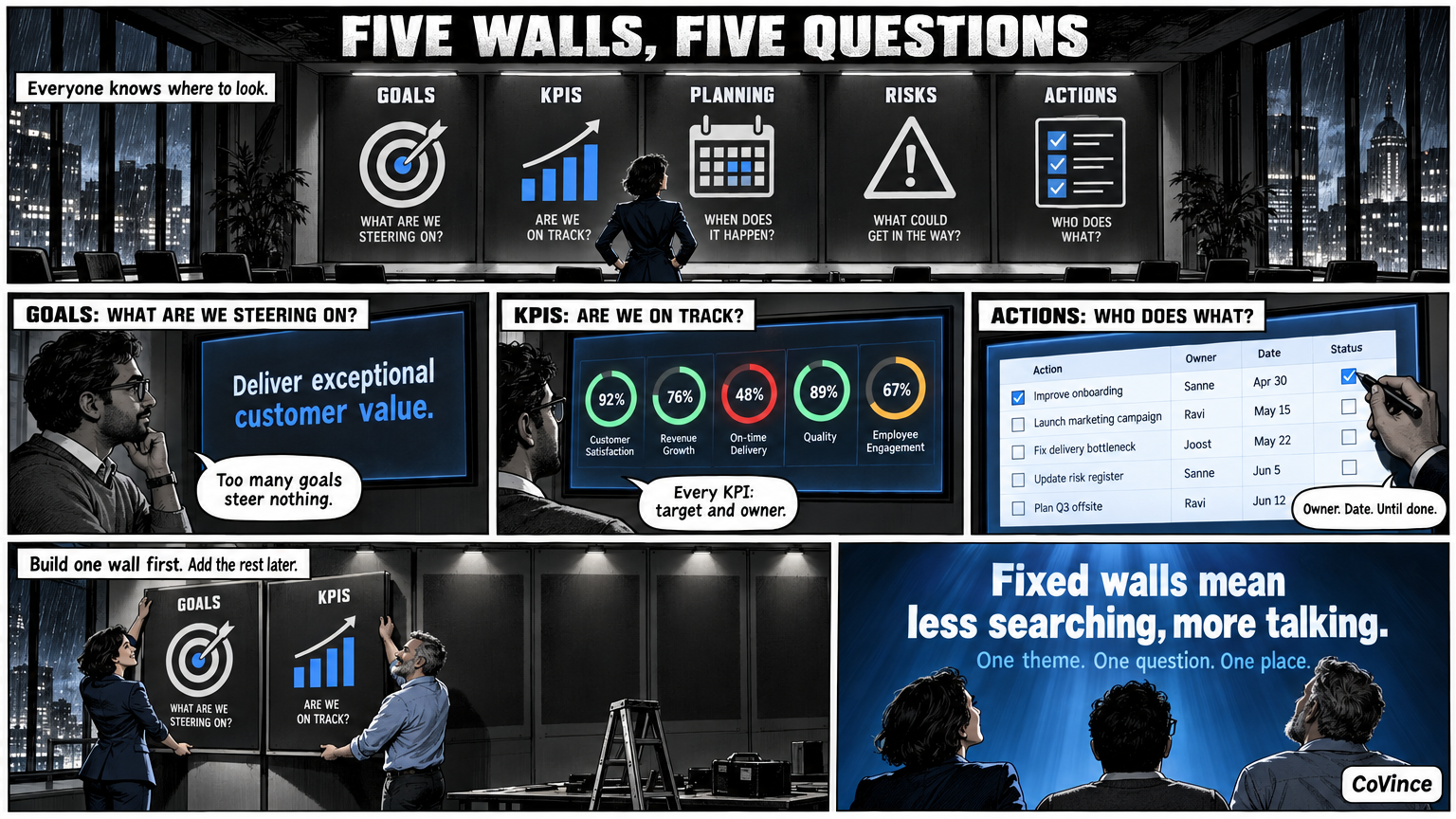
An Obeya wall has five fixed themes: goals, KPIs, plan, problems and actions. Each theme answers its own question and has a fixed place, so you always know where to look. Below we walk through them one by one, with real screenshots of the CoVince Control Room.
Why fixed walls
An Obeya works because everyone knows where to look. If the goals sometimes hang on the left and sometimes next to the plan, everyone searches and nobody talks. That is why each wall has a fixed subject, and that subject a fixed question. The five themes below return in almost every Obeya, in industry, healthcare, IT and government.
You do not have to build all five at once. Start with one, usually goals and KPIs, and add the rest when the rhythm is in place. For that rhythm, see Obeya stand-up: agenda and rhythm.
1. Goals: what are we steering on?
The first wall shows what the team is there for. What has to stand at the end of the project or programme? Keep it short: a goal that does not fit on a screen is one the team itself does not know by heart.
- Question: what do we want to achieve, and for whom?
- What belongs on it: one or two sentences about the goal, the main results and, if useful, the reason behind it.
- Pitfall: too many goals. If everything is a goal, nothing steers.
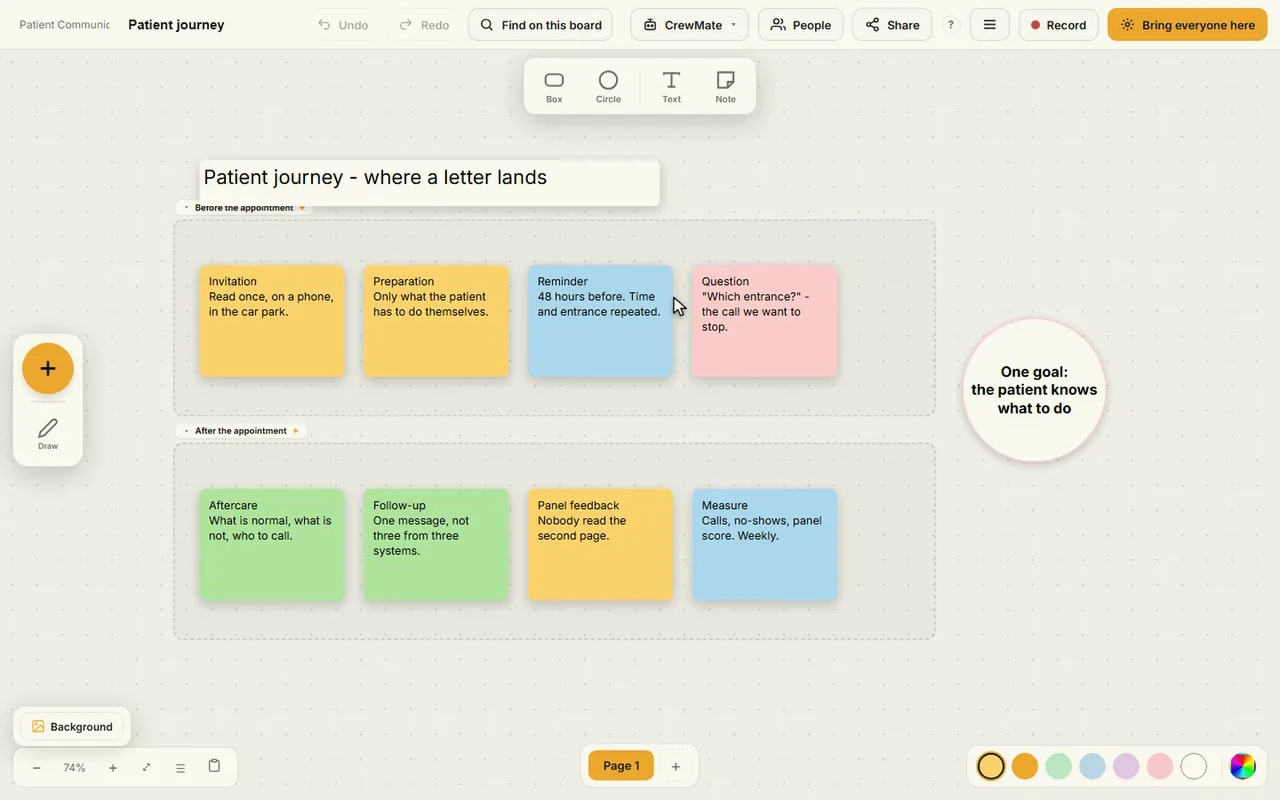
On the CoVince canvas you can put the goal next to the journey it is about. That way it stays visible at the moment someone decides something.
2. KPIs: are we on track?
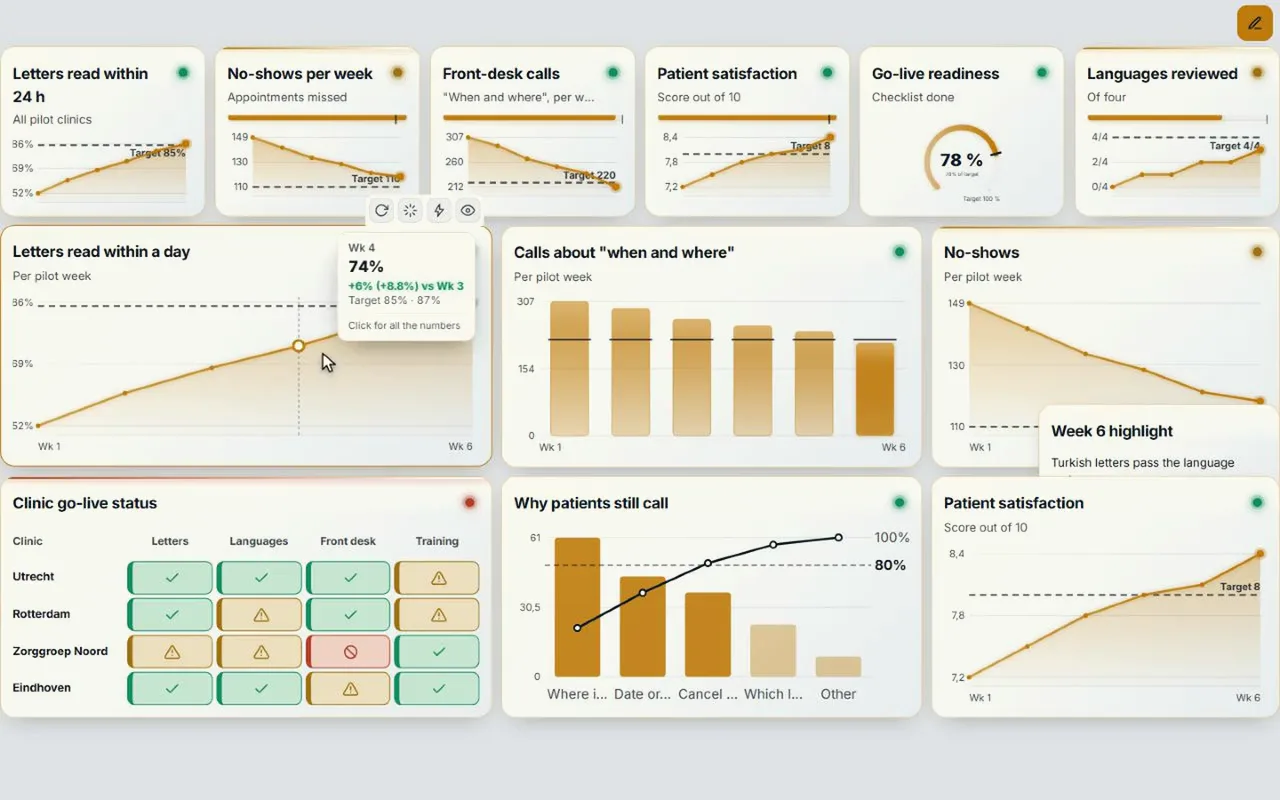
The second wall is the place for the numbers. Every measurement has a target and a colour: green, orange or red. It is the part of the wall that changes the most, and therefore the part that falls behind first when you work with paper.
- Question: are we on track, and which way is it heading?
- What belongs on it: five to eight KPIs with their target, a trend and an owner.
- Pitfall: a number without a target. Then nobody knows whether 86 is good or bad.
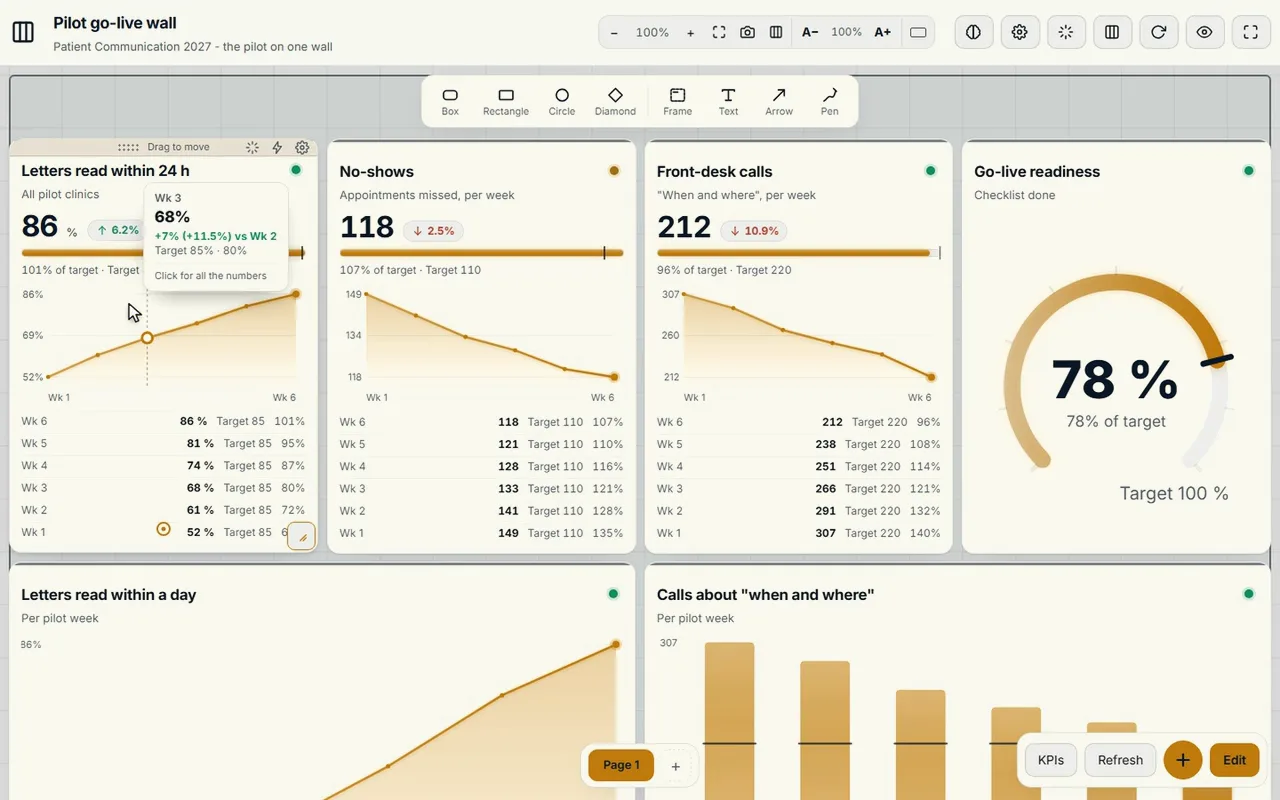
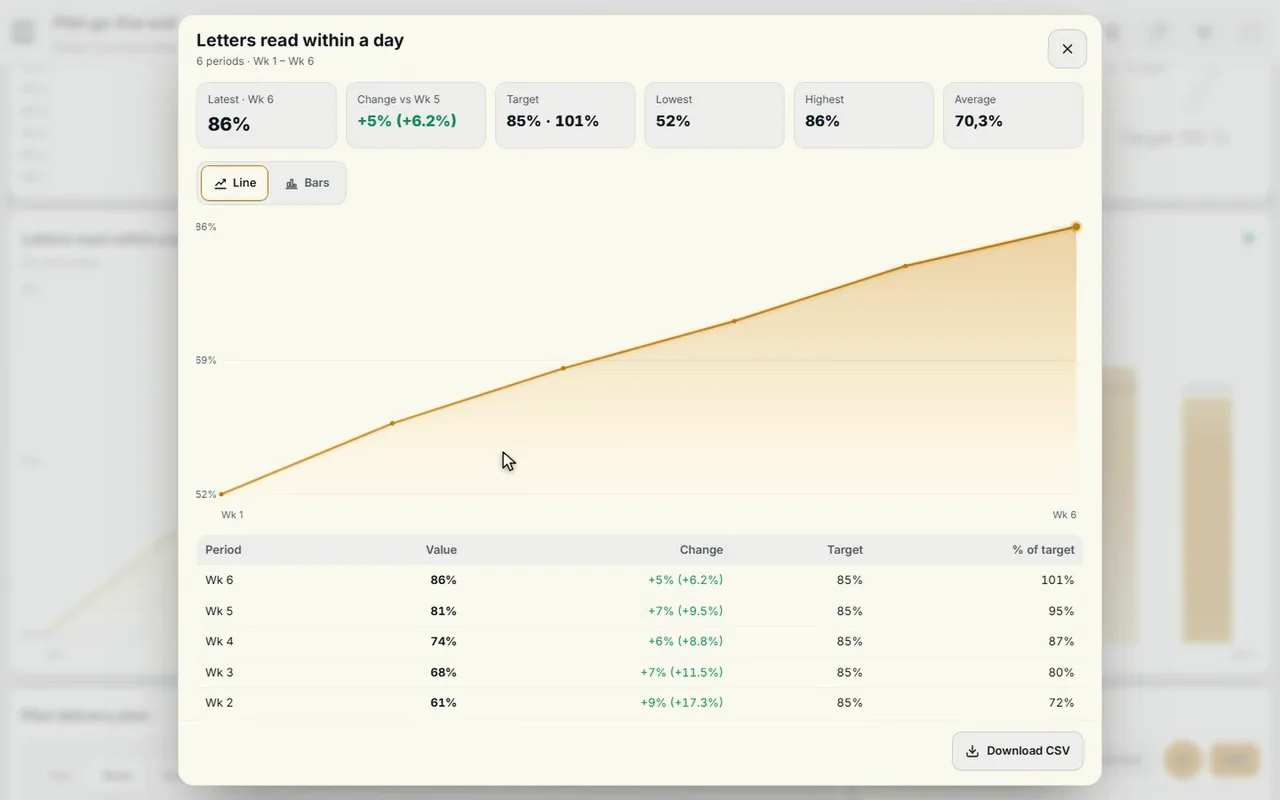
In the Control Room you tap a tile and see the trend per week, against the target. That is handy in the stand-up: you do not have to hunt for the chart in another tool.
3. Plan and milestones: what has to happen?
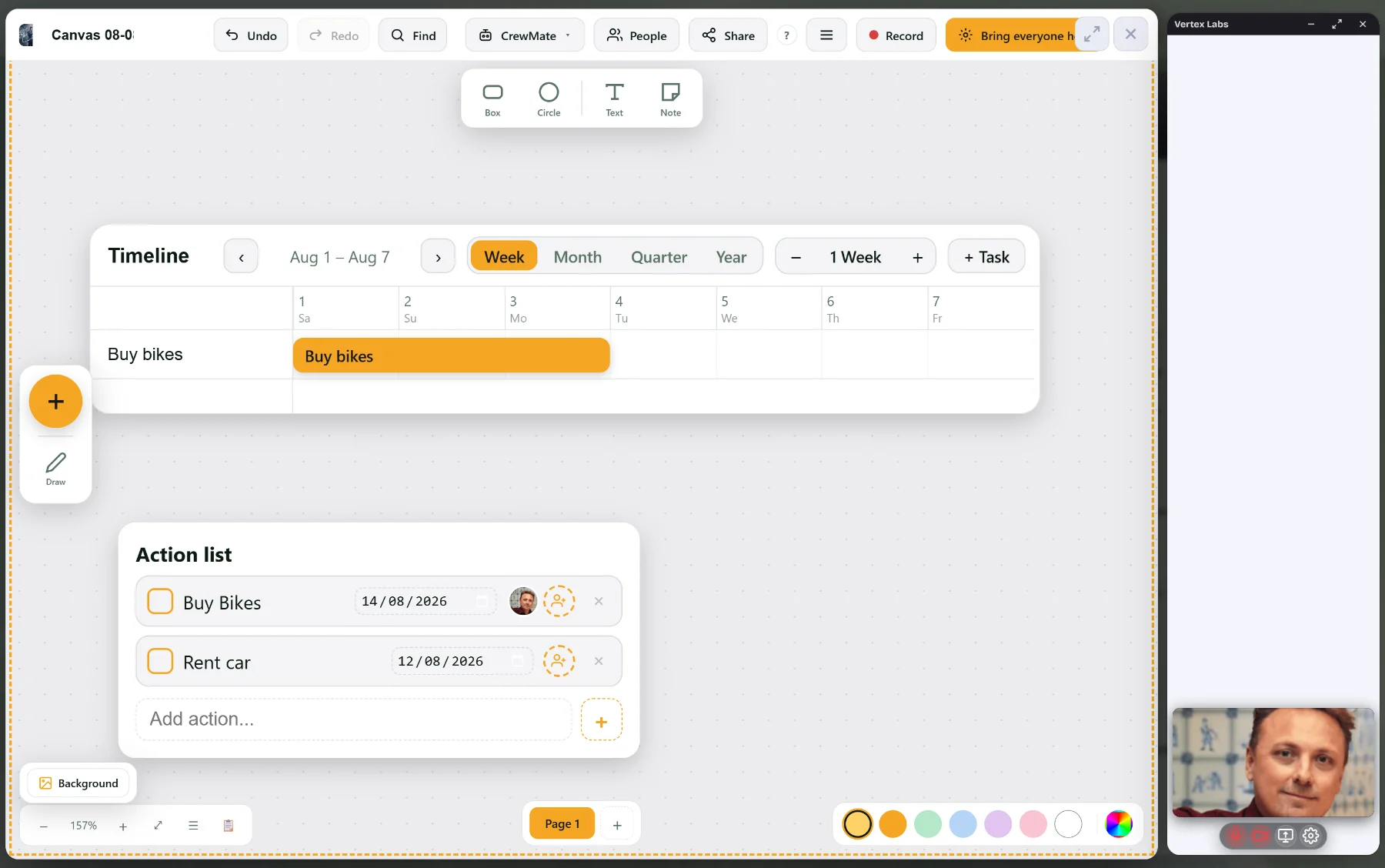
The third wall shows the phases, the milestones and who picks up what. It is the wall that answers: what has to happen this week, and what is next?
- Question: are we on schedule?
- What belongs on it: a timeline with phases and milestones, supplemented with the dependencies the team is waiting on.
- Pitfall: a plan that was made a month ago and has not been updated since.
4. Problems: what is not going well?
The fourth wall is the honest wall. Here hangs what is not going well: a deviation in a KPI, a blocker, a risk that is getting closer. An Obeya that skips this part is a notice board with good news.
- Question: what is not going well, and why?
- What belongs on it: the deviations, with the cause as far as known. In CoVince four statuses show what needs attention: behind, at risk, overdue actions and on track.
- Pitfall: hiding problems because red feels like failure. A wall that is always green probably shows nothing.
5. Actions: what do we do about it?
The fifth wall is what it is all about. Every problem on the fourth wall gets an action here. An action has an owner and a date, and stays up until it is done.
- Question: who does what, and when is it done?
- What belongs on it: an action list with owner, date and the KPI or risk the action belongs to.
- Pitfall: actions without an owner or without a date. Then the action quietly disappears and the problem comes back.
In CoVince the action hangs on the board it is about: tap a chart and you see which action is attached to it. What comes up in the stand-up you work out on a canvas, in a document or a spreadsheet, in the same journey.
Five themes, four walls
On CoVince’s Obeya page there are four: goals and KPIs, plan and milestones, problems and actions, and decisions and risks. That is a different cut of the same material. Goals and KPIs then stand together, because you want to see the goal next to the number; problems and actions stand together, because a problem without an action achieves nothing; and decisions and risks get a wall of their own so nobody makes a decision twice and nobody forgets a risk. How to divide them physically over screens you can read in Obeya room setup.
In which order to build them
- Goals and KPIs. Without numbers and goals you cannot steer anything.
- Actions. Immediately attach an action with owner and date to every red KPI.
- Problems and risks. Once the rhythm is in place, make visible what stands in the team’s way.
- Plan and milestones. Add the plan when the stand-up has become a habit.
The full explanation of the method is in What is Obeya? The complete guide. Examples of KPI walls are in KPI wall examples.
Frequently asked questions
Which five walls does an Obeya have?
Goals, KPIs, plan and milestones, problems and actions. Each theme has its own question and a fixed place on the wall.
Do I have to build all five walls at once?
No. Start with goals and KPIs, attach actions to them and add the other walls when the rhythm is in place.
Why does CoVince have four instead of five?
On CoVince’s Obeya page goals and KPIs stand together, and so do problems and actions, with a wall of its own for decisions and risks. It is a different cut of the same content.
How do I see which problem belongs to which action?
In CoVince you tap a chart and see which action is attached to it. Every action has an owner and a date.
How many KPIs belong on the wall?
A handful; five to eight is a good starting point. Anything that does not drive a decision or has no owner comes off again.