
What is Obeya? The complete guide
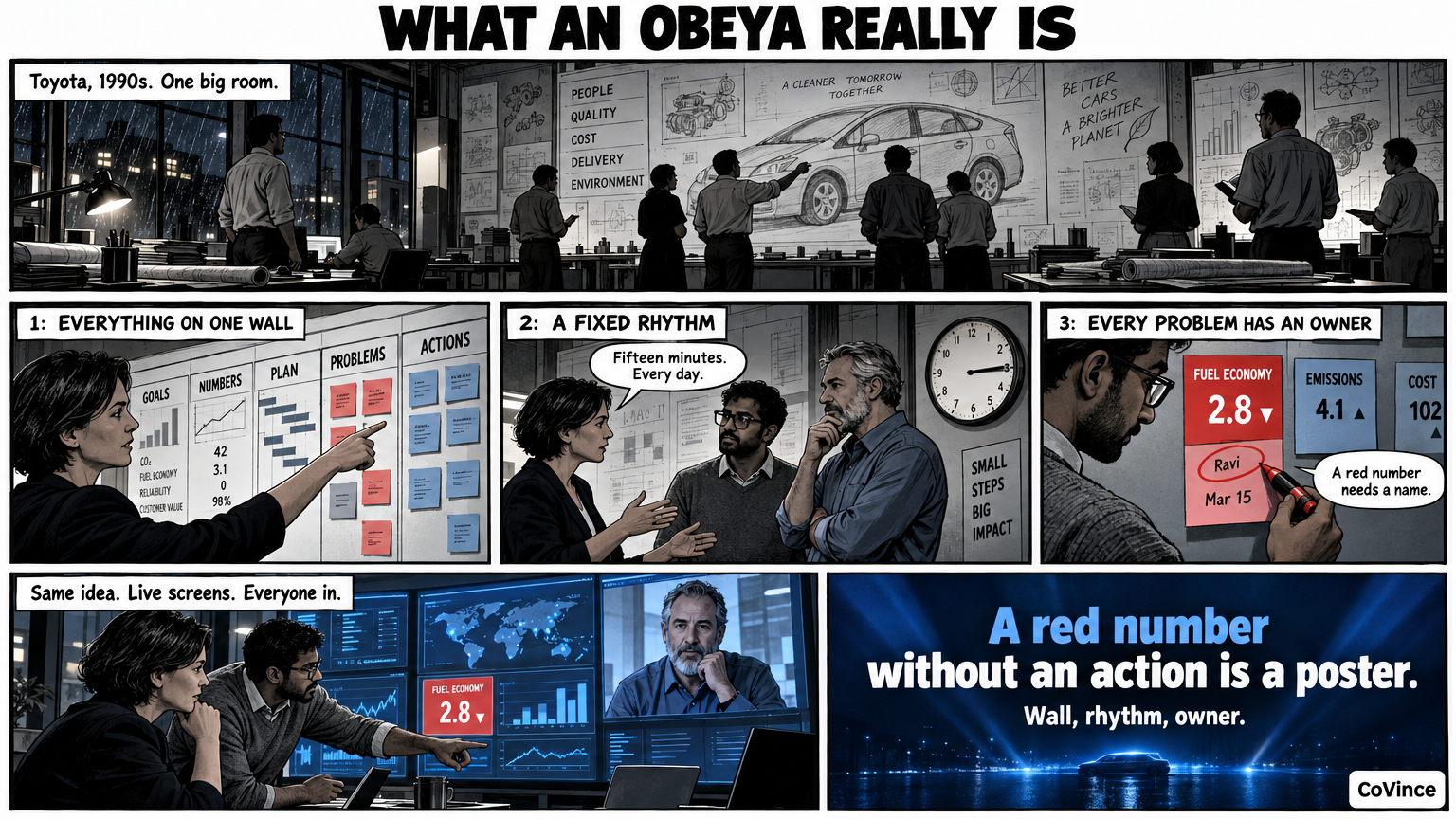
An Obeya (Japanese for “big room”) is a room where everything about a project or programme hangs on the wall: goals, numbers, plan, problems and actions. The team meets there briefly and often, sees the same information and decides faster. This guide explains where it comes from, how the wall is built, which rhythm goes with it and how to start small, even when half of the team is remote.
- What is an Obeya?
- Where it comes from: Toyota and the first Prius
- Three principles behind the wall
- How the wall is built
- The rhythm: PDCA and the stand-up
- Who does what
- Why paper is no longer enough
- The digital and hybrid Obeya
- The room: from one screen to nine
- How to start in five steps
- Which numbers go on the wall?
- An AI colleague in the room
- A week with an Obeya
- Four misunderstandings
- Checklist for your first Obeya
- What usually goes wrong
What is an Obeya?
Obeya (大部屋) literally means “big room”. It is a way of working from lean management: you set up a room where the state of a project or programme is visible on the walls. Not a collection of folders and dashboards where everyone finds their own way, but a place you walk into and see at a glance where you stand.
Three things make it an Obeya and not just a meeting room with a whiteboard:
- Everything hangs together. Goals, numbers, planning, problems and decisions are on the same wall, not in five systems.
- There is a fixed rhythm. The team stands in front of the wall at agreed moments: briefly every day, more thoroughly every week.
- Every problem has an owner and a date. A red measurement without an action is not an Obeya, it is a poster.
You find the method in industry, healthcare, IT and government. Wherever several departments work towards the same result, a shared picture helps.
Where it comes from: Toyota and the first Prius
Toyota used the Obeya in the 1990s while developing the first Prius. The chief engineer and the teams from all departments worked in one room, with everything about the project visible on the walls. The idea was simple: if design, production, purchasing and finance each sit in their own building, it takes weeks for a problem to reach the right person. If they sit in the same room, you hear it the same day.
That fits Toyota’s broader lean thinking: make work visible, remove waste and solve problems where they arise. The Obeya is the spatial expression of that. It has since become a standard lean method, far beyond car manufacturing.
Three principles behind the wall
Visual management
What you can see, you do not have to ask. The state of affairs is there for everyone, without a project manager having to write a report. It also changes the conversation: you discuss what the wall shows instead of what someone thinks is going on.
One truth
Every department looks at the same numbers and the same plan, not at its own version in its own folder. A lot of meeting time goes not to the problem itself but to the question which version of the number is right. An Obeya removes that discussion.
Problems on the table early
A deviation stands out on the wall at once and is discussed and solved there, not weeks later in a report. A red status in an Obeya is not a disgrace but the start of the conversation. That only works if it is safe to report red, and that takes leadership, not software.
How the wall is built
The wall follows a fixed layout, so you always know where to look. Variants exist, but five themes keep coming back:
- Goals: what do we steer on and what result do we want?
- KPIs: are we on course? Every measurement has a target and a colour: green, amber or red.
- Plan and milestones: the phases, the milestones and who picks up what. What has to happen this week?
- Problems: what is not working, and why?
- Actions: what do we do about it? Every action has an owner and a date, until it is done.
On the CoVince Obeya page these themes are combined into four walls: goals and KPIs, plan and milestones, problems and actions, and decisions and risks. That is not a different method, just a different cut. What counts is that every subject has a fixed place. The five Obeya walls walks through the themes one by one.
The rhythm: PDCA and the stand-up
An Obeya is not a poster but a rhythm. The core is Deming’s PDCA cycle: Plan, Do, Check, Act. Every time the team stands in front of the wall, the same questions come back: what did we plan, what happened, where do we deviate, and which action do we start now?
- Daily: a stand-up of fifteen minutes. What is red, who picks it up?
- Weekly: walk the walls together: plan, risks and decisions.
- Per period: recalibrate goals and KPIs. Are we still steering on the right things?
The rhythm makes the difference between a wall that lives and a wall nobody looks at after three months. The stand-up is described step by step in Obeya stand-up: agenda and rhythm.
Who does what
An Obeya needs few roles, but they have to be clear:
- The owner of the Obeya (often the programme or project lead) guards the rhythm and keeps the wall current.
- Every KPI has an owner who can explain why the number is what it is.
- Every action has an owner and a date. Without that, a problem stays where it is.
- Participants from all departments involved. An Obeya that only the project group attends misses the point.
An example with demo names: Sanne leads the go-live programme at Meridiaan B.V. She opens the stand-up with the red tiles. Next to “readiness” sits an action in the name of the service-desk colleague, due Thursday. Nothing needs explaining and nobody has to ask who does what.
Why paper is no longer enough
The classic Obeya is paper: printouts, sticky notes and markers on the wall. That works well as long as everybody stands in the same room and the numbers change slowly. In practice it goes wrong on two points.
First, a paper Obeya only works for the people in the room. Whoever works from home or at another site does not see the wall. Second, a printed chart is out of date before the marker has dried. Somebody has to renew the printouts, and the moment that becomes too much work, nobody looks at the wall any more.
The digital and hybrid Obeya
A digital Obeya keeps the strength of the wall and solves those two things. In CoVince the Control Room is the heart: a board of tiles that spreads over one, three or nine screens. Every screen gets a name and the board shows what needs attention, with four statuses: behind, at risk, late actions and on track.
A few things you notice:
- Tap a tile and you see the course per week against the target. Tap a chart and you see which action belongs to it.
- The CrewMate is an AI colleague that knows the journey and the board. In the Obeya you just talk to it, also out loud. It suggests; you decide what goes on the wall.
- Working together happens in the same journey: what comes up in the stand-up you work out on a canvas, in a document or in a spreadsheet, with actions and timeline next to it.
- Video calling is built into CoVince. The remote colleague stands on the wall, the board stays in the middle. Everybody sees the same live wall.
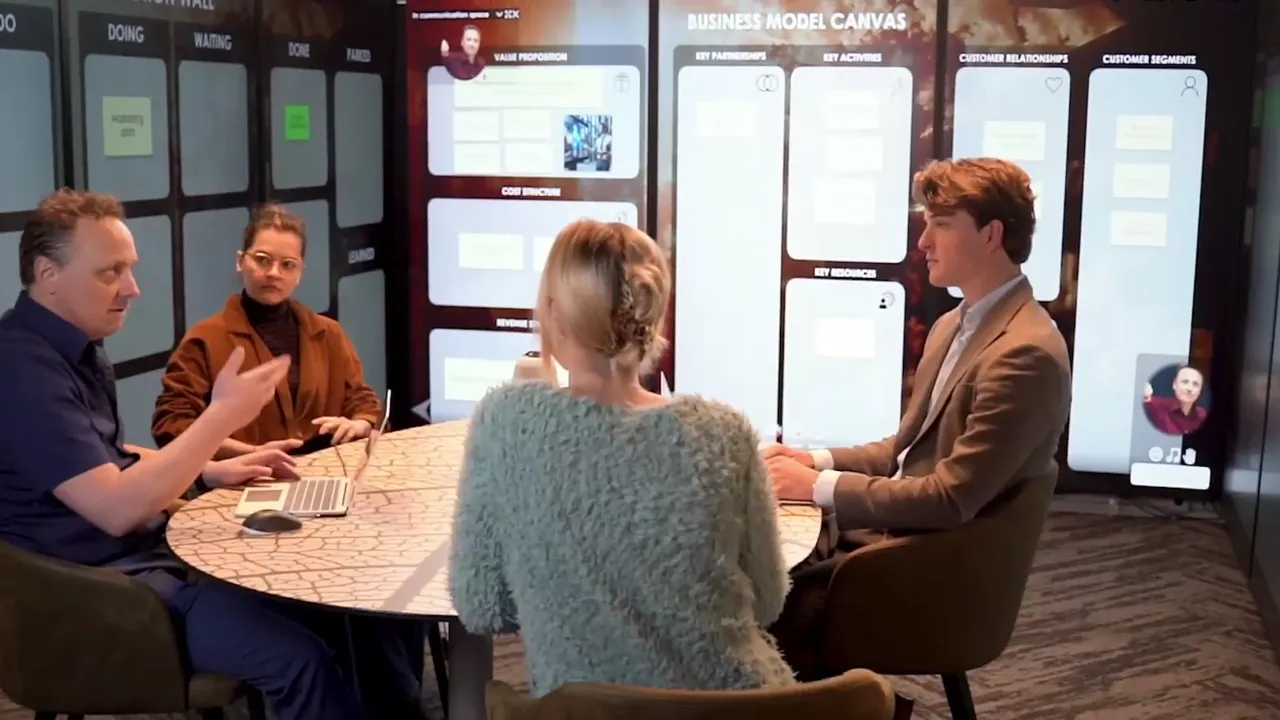
More on what this means for your work in Digital Obeya and Hybrid Obeya.
The room: from one screen to nine
You do not need a special room. A digital Obeya works on a laptop or on one big screen. If you want the wall physically around you, there are set-ups to fit the team:
- Three portrait screens side by side: goals and KPIs on the left, the CrewMate in the middle, what needs attention on the right. Enough for a fifteen-minute stand-up with a small team in an ordinary meeting room.
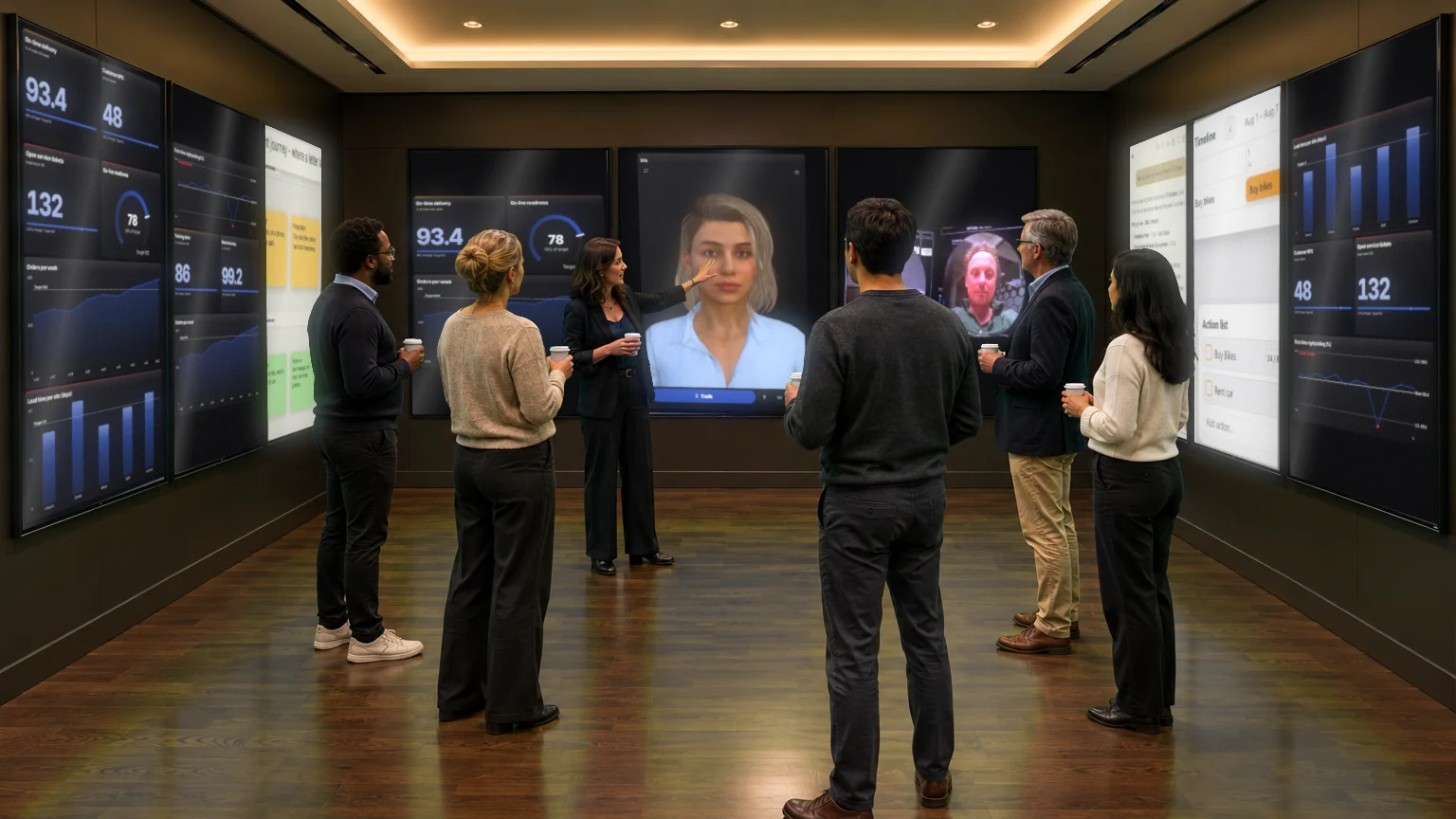
- Nine portrait screens in a U, three per wall, like the 86-inch screens in the Syner Suite. Every wall a theme; the team walks the walls. Fits programmes with several teams and the weekly session.
- Three continuous LED walls, without edges, for large sessions, steering groups and presentations.
The Syner Suite is CoVince’s immersive room: nine portrait 86-inch screens in a U, with the Control Room, the canvas and the conversation on them. You operate it with a tap on the wall or with your voice. The options are compared in Obeya room setup.
How to start in five steps
- Pick a defined subject. A programme, a go-live or a department. Not the whole company at once.
- Start with one wall. Goals and KPIs are usually the best start. Choose just a few you really steer on.
- Set the rhythm. Every day fifteen minutes, at the same time, standing in front of the wall or the screen.
- Hang actions on it. Every red measurement gets an action with an owner and a date.
- Add walls once the first wall is a habit: plan first, then problems and risks.
You do not need to know lean to begin. A short description of your subject is enough for a first board; in CoVince the CrewMate helps set it up.
Which numbers go on the wall?
The temptation is to put everything you can measure on the wall. Don’t. A good Obeya wall has a handful of KPIs the team can really influence. A few questions help you choose:
- Does this number drive a decision? If not, it is information, not a KPI.
- Does it have a target? A number without a target is a fact. Only with a target do you see green, amber or red.
- Can somebody influence it? Every KPI has an owner who can do something when the number deviates.
- Is it current enough? A monthly figure in a daily stand-up adds little. Pick a rhythm that fits the number.
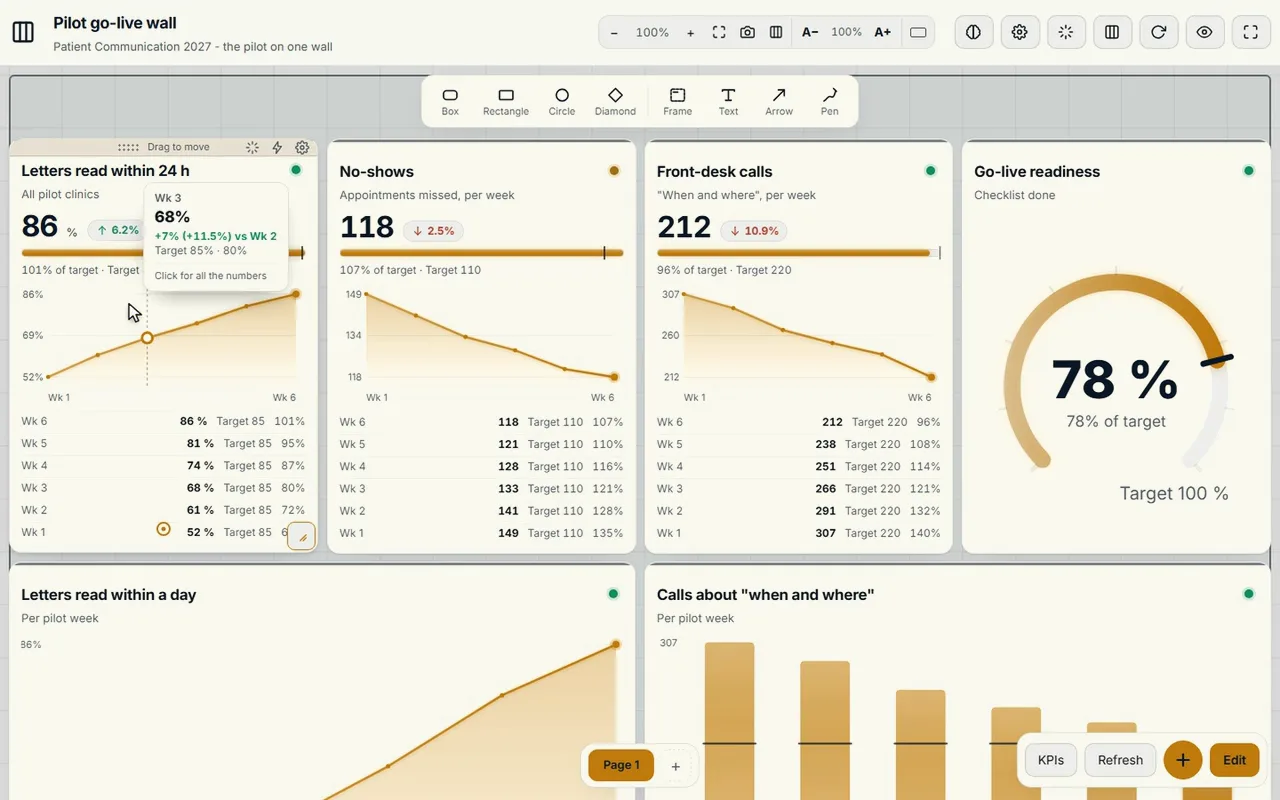
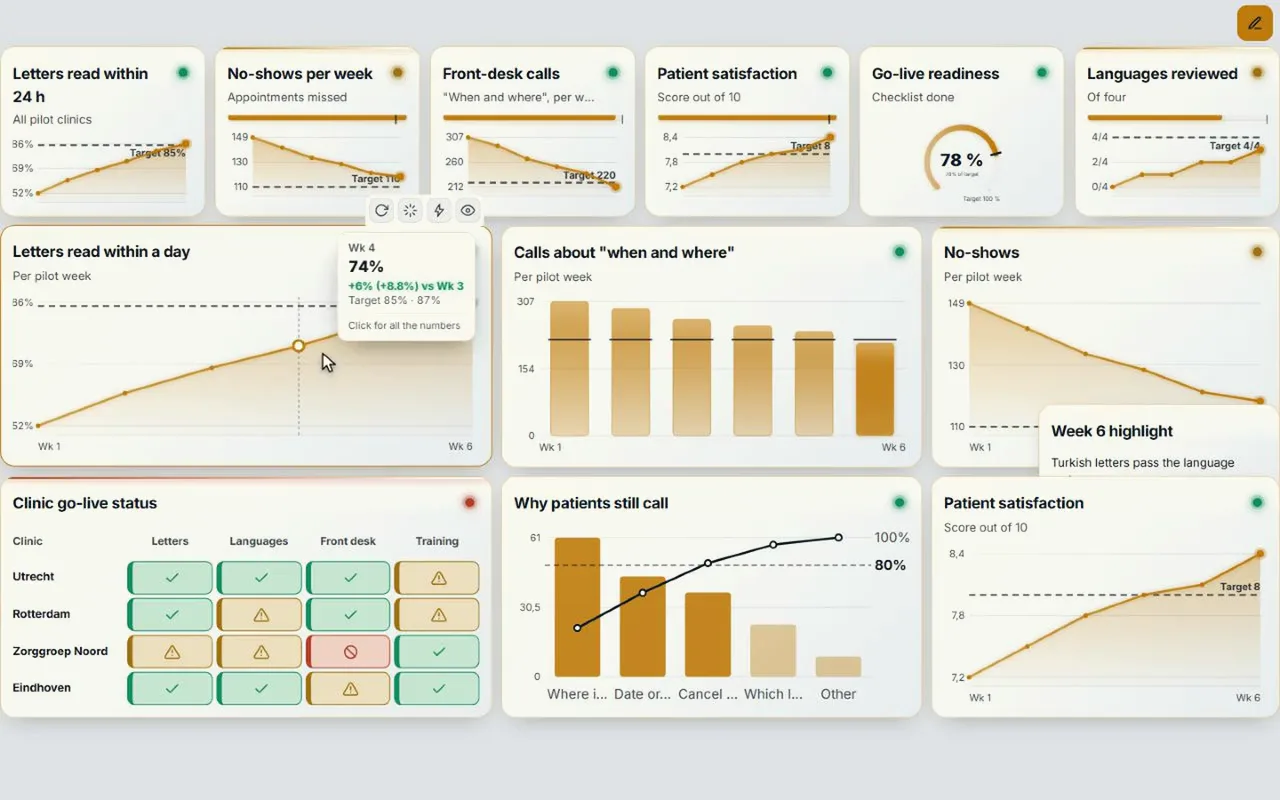
On the demo wall of a go-live you can see what that looks like: letters read within 24 hours, missed appointments per week, front-desk calls and a readiness gauge. Each KPI shows its target plus the course per week. So you see not only whether you are above or below the line, but also which way it is heading.
An AI colleague in the room
A newer layer in the digital Obeya is the CrewMate. It is an AI colleague that knows the journey and the board: it knows which KPIs are on the wall, which actions are attached and how the numbers develop. You can ask it a question about the figures and you get an answer, also out loud, so your hands stay free during the stand-up. It suggests, you decide what goes on the wall. An Obeya does not become less human because of it: the conversations stay with the team, while the CrewMate looks up the number and helps set up a plan with owners and dates.
A week with an Obeya
What does it feel like in practice? An example with demo names, at Meridiaan B.V.
Monday. Sanne opens the stand-up. Three tiles are red. The first belongs to the service desk: there are more calls than planned. There is already an action for it, with an owner and a date. The second tile just turned red; nobody knows why yet. An action is added, with an owner and a Wednesday date. The third is a known risk and stays as it is.
Wednesday. The stand-up takes fifteen minutes. The new red tile turns out to be a data issue: the source was a day behind. A colleague working from home is on the wall and gives the answer. The action is ticked off.
Friday. The weekly session: the team walks the walls. The plan is on schedule, two risks get an owner, and a decision about the training date is recorded on the wall, so nobody has to take it again in three weeks.
None of this is spectacular, and that is exactly the point. Most of the work in an Obeya is dull rhythm: the same questions, every day, in front of the same wall. The gain is in what does not happen: no email chains about which version is right, no surprises in the monthly report, no action that quietly disappears.
Four misunderstandings
“It is a dashboard on the wall.”
A dashboard shows numbers. An Obeya shows numbers and forces the conversation and the action. The difference is in the rhythm and the owners: you can ignore a dashboard, you cannot ignore a stand-up in front of the wall. A digital Obeya needs dashboards, but is not finished with them.
“It is for large programmes.”
Toyota started big, but the principle scales down. A team of six that discusses five KPIs and an action list on one screen is doing Obeya. The room, the number of screens and the number of themes grow with what you need, not the other way round.
“It only works if everybody is in the same room.”
That was true for the paper version. With a digital wall and video calling on the wall, everybody is in the same Obeya anyway, even when half the team works from home. The set-up has to be built for it: the remote colleague gets a fixed place on screen and the same live wall, not a shared screen that disappears after ten minutes.
“If the wall is red, we are doing something wrong.”
The other way round: a wall that is always green probably shows nothing. Red is information. The question is not why it is red, but what the action is, who picks it up and when it will be done. Teams that learn this report problems earlier. That is the whole gain of the method.
Checklist for your first Obeya
- There is a defined subject with a clear owner.
- There are at most five to eight KPIs on the first wall, each with a target and an owner.
- The stand-up is in everybody’s calendar, at the same time, for fifteen minutes.
- Every red KPI has an action with an owner and a date.
- It is clear where the numbers come from: from CoVince itself, from a CSV, from connected sources or typed in.
- Whoever is not in the room can watch and talk along.
- After four weeks you look back: which tiles led to decisions and which did not? Remove what delivers nothing.
What usually goes wrong
Most Obeya rooms do not die of a wrong method but of creeping sloppiness:
- The numbers get out of date and nobody trusts the wall any more.
- Actions have no owner, or the date passes without anybody noticing.
- The wall becomes a presentation instead of a workplace.
- Remote colleagues are out of frame, so the real conversation happens elsewhere.
- There are too many KPIs; everything is important, so nothing stands out.
In Why nobody looks at the Obeya wall after three months we go deeper into these pitfalls. Want to know how the Obeya relates to familiar ways of working? Read Obeya, Kanban or Scrum board?.
Frequently asked questions
What is an Obeya in one sentence?
An Obeya is a room, physical or digital, where goals, numbers, plan, problems and actions of a project or programme are visible together, so a team steers on them briefly and often.
What does Obeya mean?
Obeya is Japanese for "big room". Toyota used the method in the 1990s while developing the first Prius, with all departments in one room and everything about the project on the walls.
Do we need to know lean before we start?
No. Start with one wall and one stand-up. The Obeya view in CoVince shows what needs attention, and the CrewMate helps with the first board.
Do we need a special room?
No. A digital Obeya works on a laptop or on one big screen. The Syner Suite is for those who also want the walls physically around them.
How often does the team meet at the wall?
A daily stand-up of fifteen minutes, a weekly walk along the walls for plan, risks and decisions, and per period a recalibration of goals and KPIs.
Does an Obeya work when part of the team is remote?
Yes, if the wall is digital. In CoVince video calling sits next to the board and everybody sees the same live wall, also those who are not in the room.
What is the difference between an Obeya and a war room?
A war room is a space for a temporary, urgent task; an Obeya is a lasting way of working with goals, numbers, plan, problems and actions on the wall. The setups look alike. Read Obeya, war room and big room planning.