
Obeya stand-up meeting: agenda, rhythm and who says what
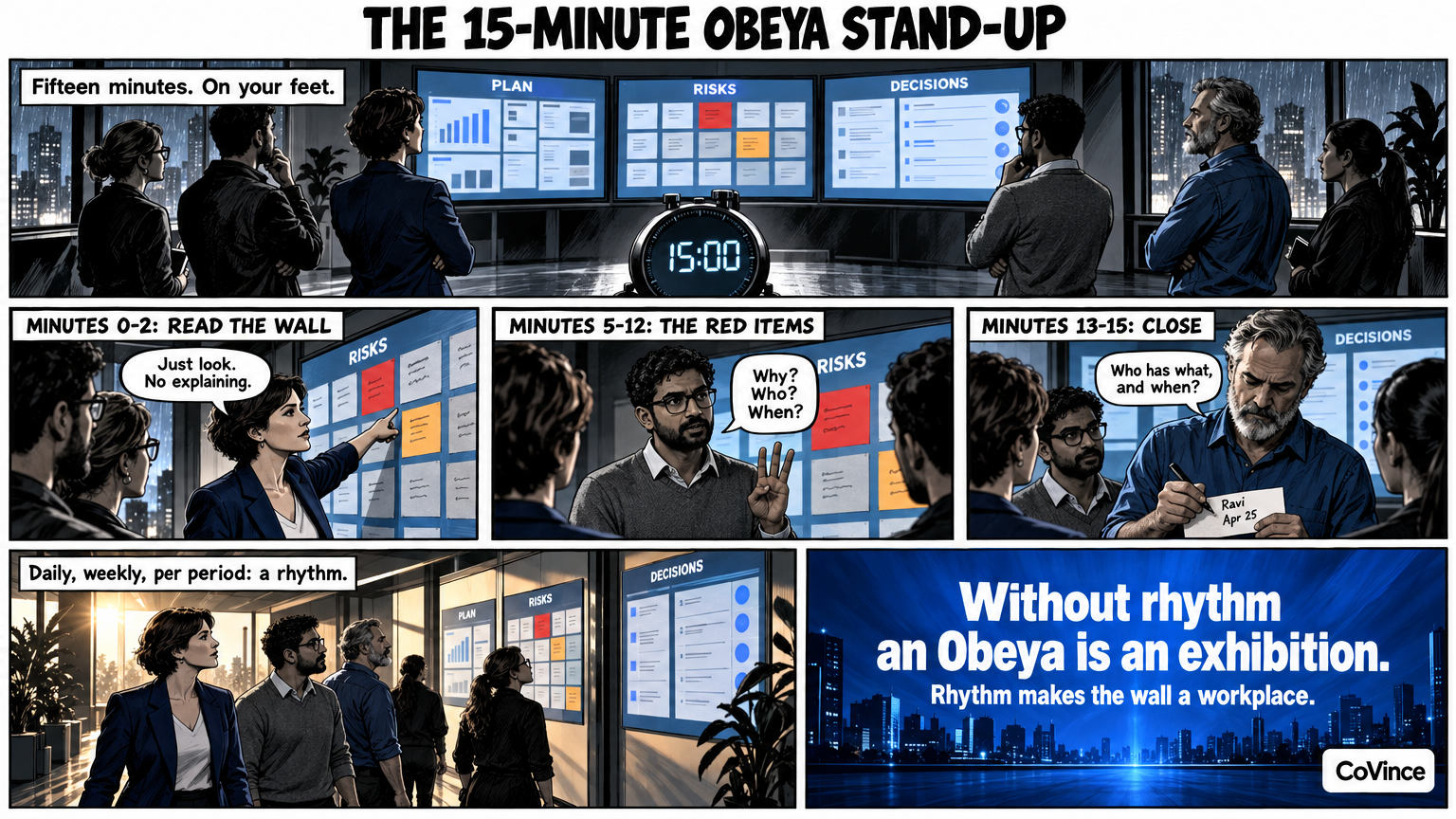
An Obeya stand-up meeting is fifteen minutes on your feet in front of the wall, every day at the same time, always with the same question: what is red and who picks it up? Around it sits a rhythm of a weekly session for plan, risks and decisions, and a periodic recalibration of goals and KPIs. Below is an agenda you can use tomorrow, with the roles.
The rhythm in three layers
An Obeya lives on short, fixed moments in front of the wall. Not a poster but a rhythm, with three layers that each have their own question:
| Moment | What you do | Question |
|---|---|---|
| Daily | Stand-up of fifteen minutes | What is red, who picks it up? |
| Weekly | Walk the walls together: plan, risks and decisions | Are we on schedule, what can still hit us, what has been decided? |
| Per period | Recalibrate goals and KPIs | Are we still steering on the right things? |
Without this rhythm an Obeya is an exhibition. The rhythm turns the wall into a workplace.
The 15-minute agenda
The stand-up is short because it is held standing, in front of the wall, and because only what the wall shows can be discussed. An agenda that works:
- Minutes 0-2: read the wall. The facilitator walks along the wall and names what is red, orange or new. No explanation, just looking.
- Minutes 2-5: what has changed since yesterday? New deviations, completed actions, new risks.
- Minutes 5-12: the red items. Three questions per red item: why, who picks it up, when is it done? Each item ends in an action with an owner and a date, or in the decision to leave it.
- Minutes 12-14: yesterday’s actions. What is done, what is slipping? An action that slips gets a new date or a new owner, not silently more time.
- Minutes 14-15: close. Any blockers that have to be solved outside the team, and who takes them along.
Longer than fifteen minutes? Then it becomes a meeting. An item that needs explanation gets an action for a separate conversation with those involved, after the stand-up.
Who says what
- The facilitator (often the owner of the Obeya) keeps time, walks along the wall and makes sure every red item gets an action. You may rotate the role; that makes the team the owner of the wall.
- The KPI owner says in one or two sentences why the number is what it is. No more.
- The action owner reports whether the action is done, and if not, when it will be.
- Everyone else listens, adds where their department knows something, and does not bring a discussion to the stand-up that belongs in a separate conversation.
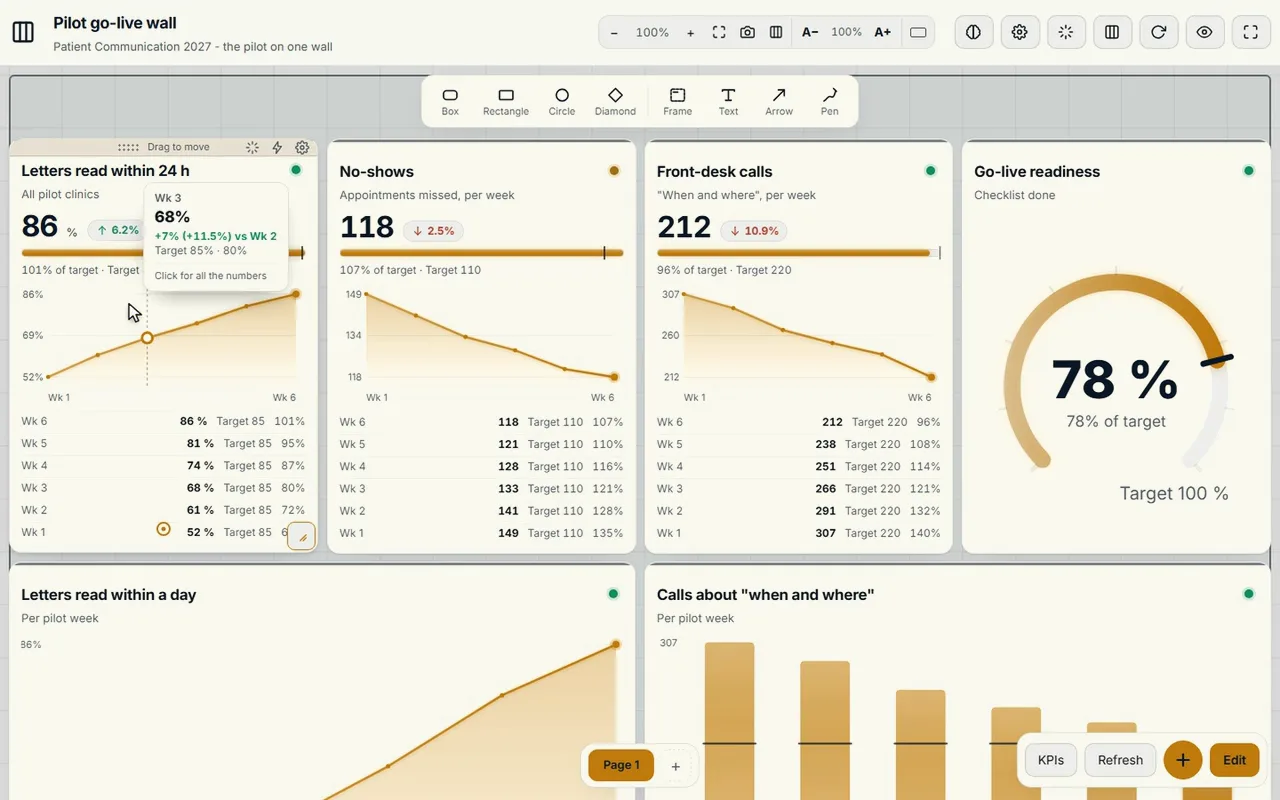
An example with demo names, at Meridiaan B.V.: Sanne leads the stand-up. At the tile ‘missed appointments’ the owner says: “Red since yesterday, the reminder email went out a day late.” Sanne asks: “Who picks it up?” An action appears with a name and tomorrow’s date. Then on to the next tile.
The questions come from PDCA
The agenda looks simple, but there is a way of thinking underneath: Deming’s PDCA cycle. The same questions every time:
- Plan: what had we planned?
- Do: what happened?
- Check: where do we deviate from the goal?
- Act: which action do we start now, with an owner?
A stand-up that does not ask these four questions quickly becomes a status round: everyone tells what they have done, nobody decides anything.
The weekly session
Once a week you walk the walls together, for longer than fifteen minutes and with more attention to what does not change daily. A structure that works:
- Plan and milestones: are we on schedule? What has to happen this week, and what is next?
- Risks: what can still hit the project? Does every risk have an owner and a measure?
- Decisions: what has been decided, and what still has to be decided? Record it on the wall, so nobody makes a decision twice.
- Actions: which are older than a week? Why are they stuck?
The weekly session suits the set-up with three walls. Each wall a theme, the team walks along the walls. How to set up the room for it is in Obeya room setup.
Per period: recalibrate
Every few weeks or every quarter you ask the question you do not ask daily: are we still steering on the right things? KPIs that never turn red and never produce an action can go. A new risk or a changed goal may call for a new KPI. Keep the wall small: better five tiles that something happens with than twenty nobody looks at.
When someone is remote
In a hybrid team the stand-up is either on a laptop or on a screen in the room. Make sure the remote colleague sees the same live wall, not a screenshot. In CoVince video calling sits next to the board: the remote colleague is on the wall and the board stays in the middle. Give the remote colleague a turn in the round, not only at the end.
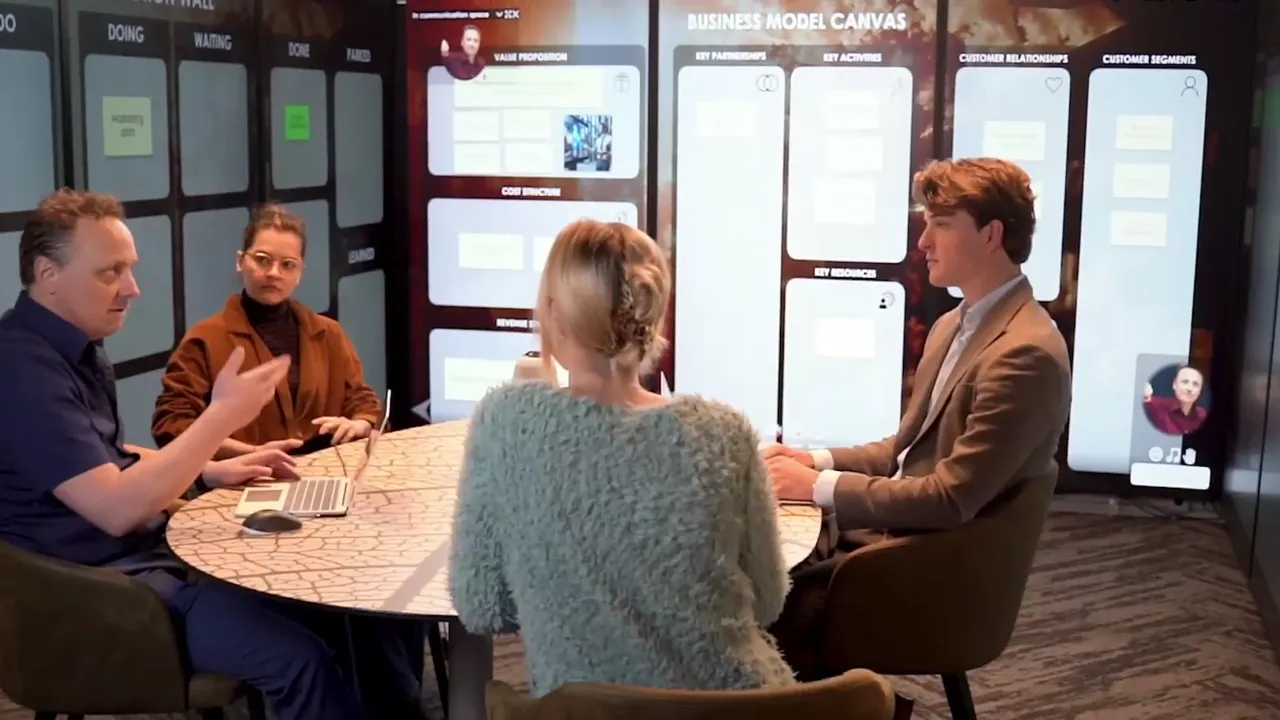
If you have a CrewMate in the room, you can ask it something about the numbers during the stand-up, out loud too. This is what that looks like in Stand-up with an AI colleague.
What not to do
- Sit down. Sitting, a stand-up takes twice as long.
- Discuss every tile. Discuss what is red or changing. Green needs no explanation.
- Solve problems in the stand-up. You name the problem, assign an owner and plan the conversation.
- Actions without a date. An action without a date is a wish.
- Let the numbers go stale. If nobody trusts the number, the whole stand-up is wasted. In a digital Obeya the numbers come from CoVince itself, from a CSV, from connected sources or are typed in; agree who keeps it up to date.
More about what usually goes wrong is in Why nobody looks at the Obeya wall after three months.
Checklist
- Fixed time, fixed place, fifteen minutes, standing.
- There is a facilitator; the role may rotate.
- The wall is current before the stand-up starts.
- Every red item ends in an action with an owner and a date.
- Yesterday’s actions are checked.
- Whoever is remote sees the same live wall and gets a turn.
- Weekly, walk the walls for plan, risks and decisions; per period, recalibrate the KPIs.
Frequently asked questions
How long does an Obeya stand-up meeting take?
Fifteen minutes, standing in front of the wall. Only what is red or changing is discussed; each red item ends in an action with an owner and a date.
Who leads the stand-up?
Often the owner of the Obeya, but the role may rotate. The facilitator keeps time, walks along the wall and makes sure every red item gets an action.
How often should the team come to the wall?
Daily for the stand-up, weekly for a session on plan, risks and decisions, and per period to recalibrate goals and KPIs.
What if someone is remote?
Make sure that colleague sees the same live wall. In CoVince video calling sits next to the board, so the remote colleague is on the wall and the board stays in the middle.
Which questions do you ask in the stand-up?
The questions from the PDCA cycle: what had we planned, what happened, where do we deviate and which action do we start now?