
Obeya vs Kanban, Scrum board and Visual Management: the difference
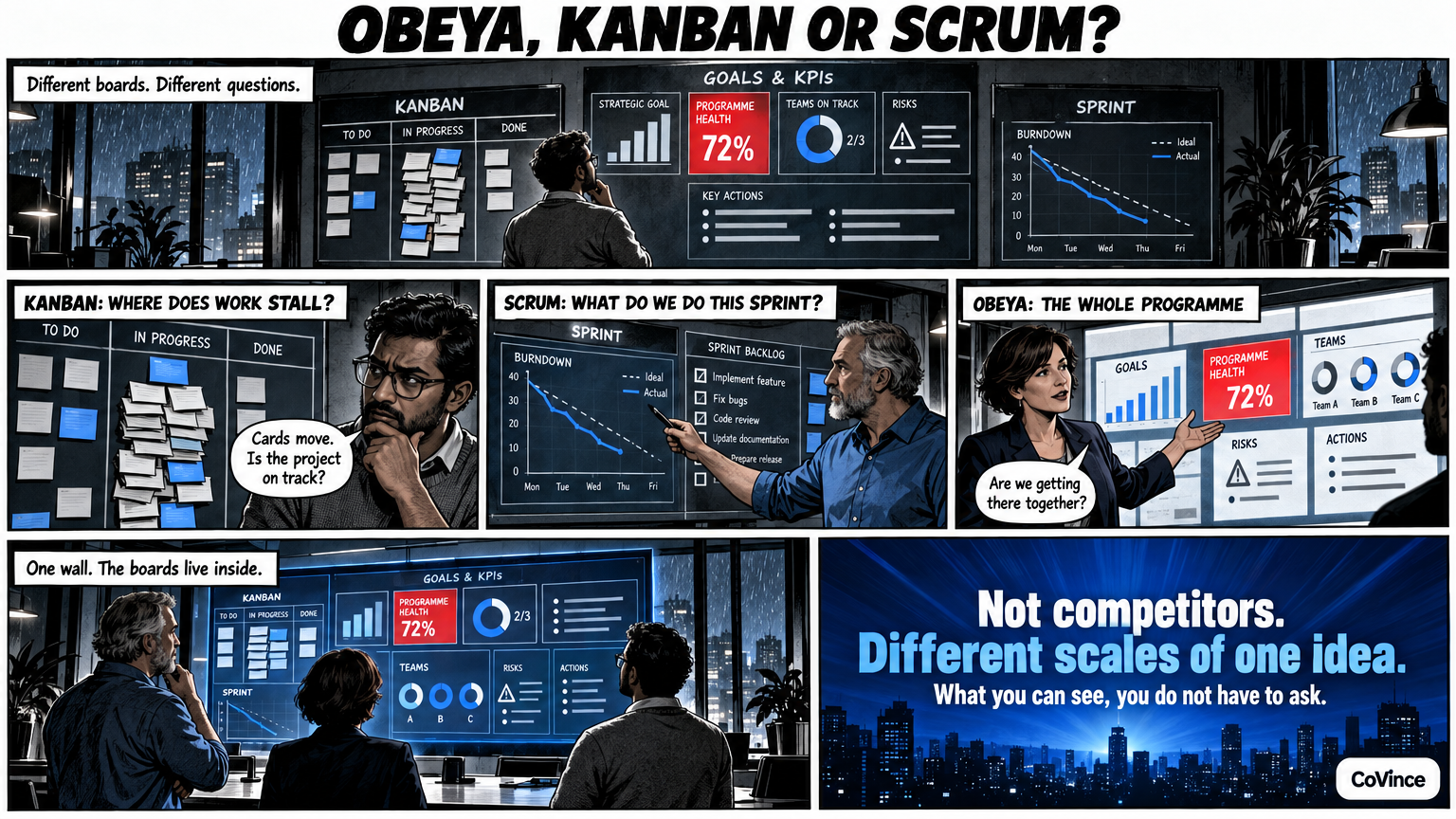
Kanban and Scrum organise the work of a team; an Obeya shows how a whole project or programme is doing. Visual Management is the principle all three rest on: make the state of affairs visible. So they are not competitors: you can use a Kanban board or sprint board as part of an Obeya wall.
Visual Management: the principle
Visual Management is not a method but an idea from lean: what you can see, you do not have to ask. A team that sees the state of affairs needs fewer meetings about it and notices deviations sooner. Kanban, the Scrum board and the Obeya are three applications of that principle, each at its own scale.
Kanban: work in progress made visible
A Kanban board shows work as cards in columns, for example ‘To do’, ‘In progress’ and ‘Done’. The aim is that you see where work piles up and that you do not start too much at once. A Kanban board is strong on the flow of work: what is under way, where does it stand still?
What it does not do: it says nothing about the goals the work serves. Whether the cards move to the right does not tell you whether the project is on track.
The Scrum board: a sprint
The Scrum board shows what the team is doing in the current sprint, with the tasks from the sprint backlog. It belongs to a fixed rhythm of sprints, with sprint planning, a daily stand-up and a review. It is built for a team that delivers products in short cycles.
The Scrum board is a team board too. It shows the sprint, not the dependencies on other teams, the budget or the risk the steering group is worried about.
Obeya: the whole programme
An Obeya looks at the whole: goals, KPIs, plan, problems, actions, decisions and risks of a project or programme, with people from all departments involved. The rhythm is fifteen minutes a day standing in front of the wall, a weekly session on plan, risks and decisions, and per period a recalibration of the goals. That rhythm follows Deming’s PDCA cycle: plan, do, check, act.
Where Kanban and Scrum say how a team works, the Obeya says how the programme is doing and what the team does about it. See also What is Obeya? The complete guide.
The comparison
| Kanban | Scrum board | Obeya | |
|---|---|---|---|
| Scale | One team, the flow of work | One team, one sprint | A project or programme, several departments |
| Shows | Cards in columns | Sprint tasks | Goals, KPIs, plan, problems, actions, risks |
| Rhythm | Continuous | Sprints with fixed moments | Daily fifteen minutes, weekly session, periodic recalibration |
| Steers on | Lead time and work in progress | The sprint goals | The results of the programme |
| Strong in | Controlling the flow of work | Delivering in short cycles | Getting all departments aligned |
Everything on one wall
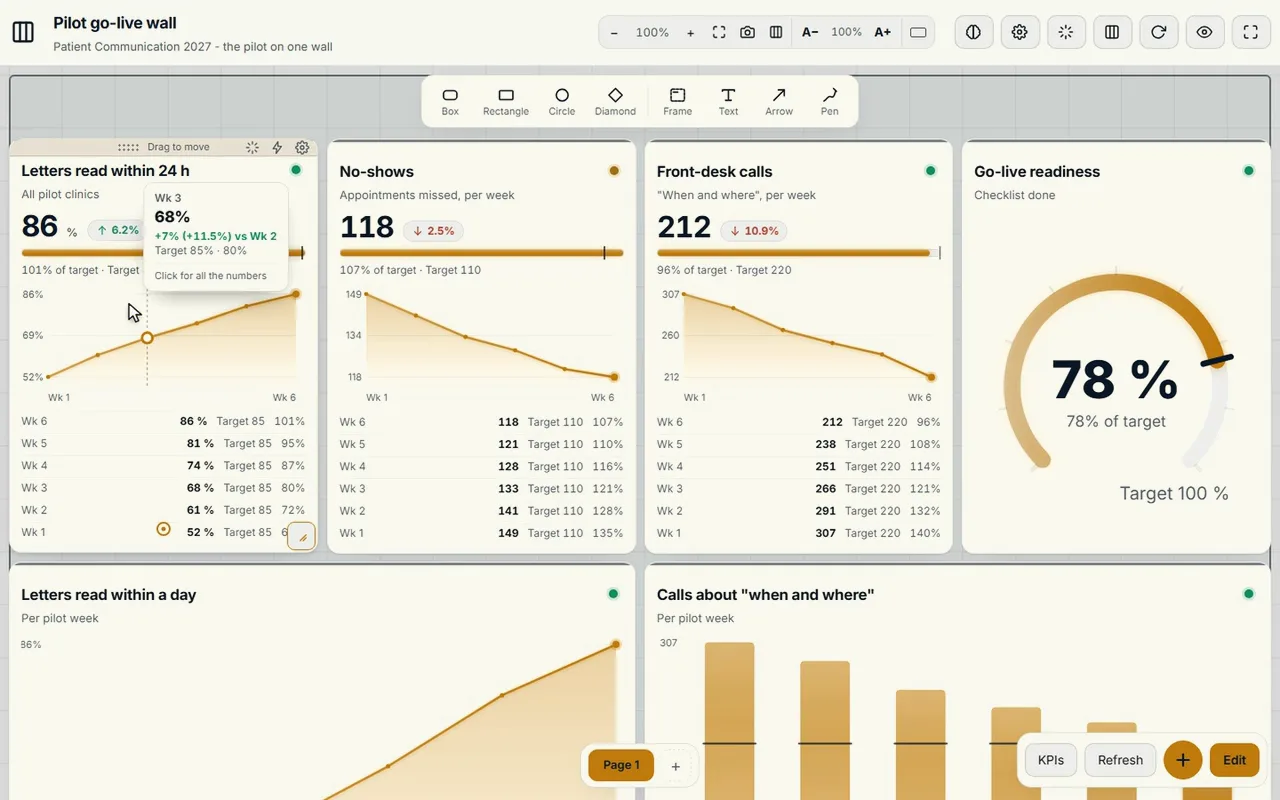
The nice thing is that you do not have to choose. An Obeya wall can contain a team’s board. The state of the sprint or the Kanban columns then hang next to the KPIs and the plan of the programme, so the team sees how its work contributes to the goal. In CoVince that lives in one journey: the Control Room for the KPIs, the canvas for the board and the actions, the timeline for the plan.
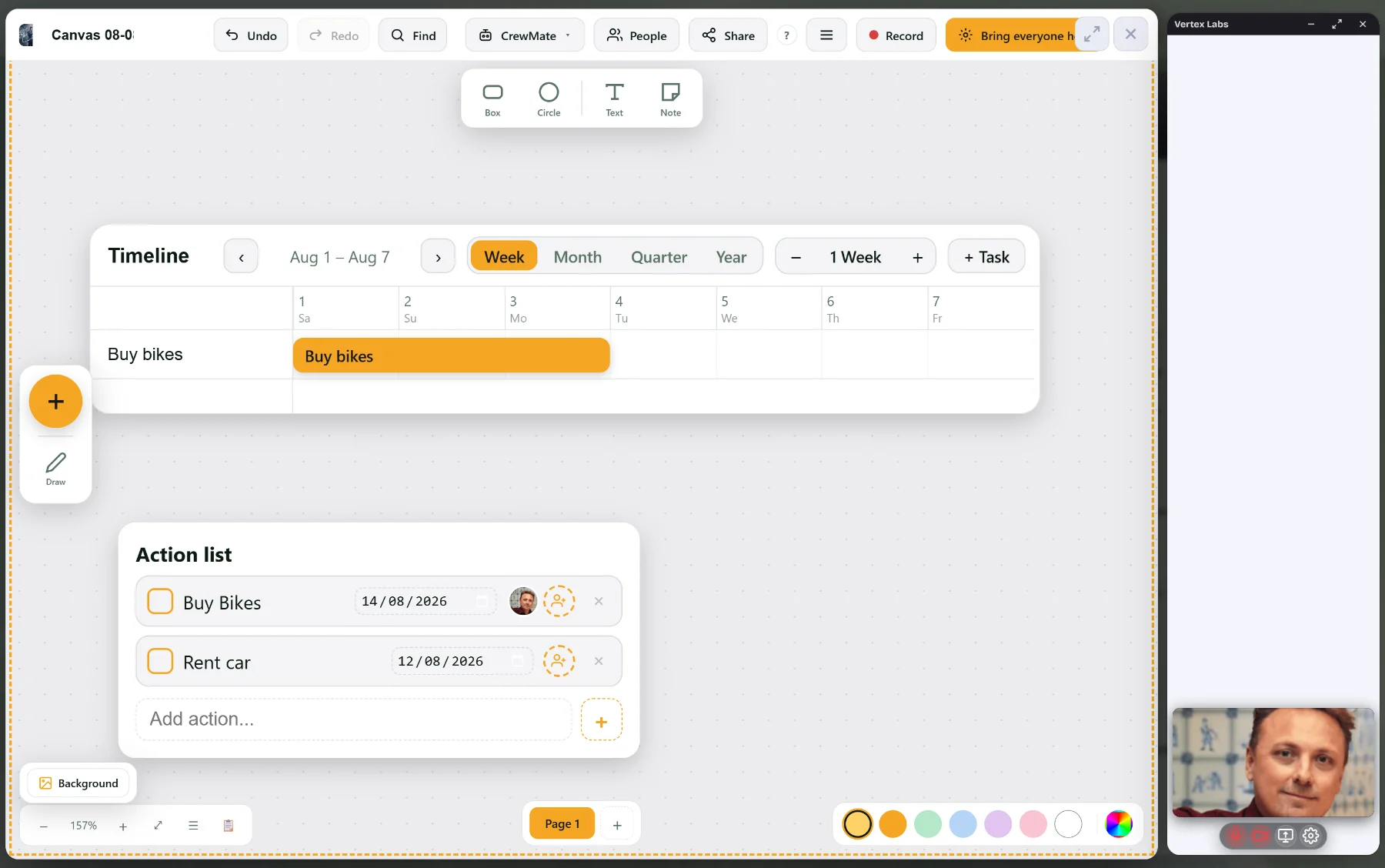
For a team that already works with a sprint board, that means: keep your board, and hang it in the Obeya next to the wall with goals and risks. You get the team’s pace and the programme picture. More on IT and agile in Obeya for IT and agile teams.
What goes wrong if you choose only one
Each of the three boards has a blind spot. Whoever only has a Kanban board or Scrum board does see what the team is doing, but not whether those are the right things. There is no place for the KPI that has been red for three weeks, for the risk that hits another department, or for the decision that was made last week. That information then lives somewhere else: in a report, in an email chain or in the project lead’s head.
Whoever only has an Obeya does see the whole, but not how a team’s work is progressing. The wall shows that a milestone is behind, not why the team’s tasks are stuck. That is what the team board is for.
An example with demo names: at Meridiaan B.V., Sanne’s IT team works in sprints. The sprint board shows that five tasks are done and three in progress. The Obeya of the go-live programme shows that readiness stands at 78 percent and that two risks still have no owner. Only when you put them side by side do you see that the three tasks in progress are exactly the ones that solve those two risks. That connection was visible in neither board.
That is why many teams do not choose one or the other, but a clear division of tasks: the team board for the work, the Obeya for the programme, and a link between the two.
When to choose what
- Only a Kanban board if you have a team that mainly wants to control the flow of work and does not steer a programme with several departments.
- The Scrum board if you work in sprints and the sprint is central.
- An Obeya if several departments or teams work towards the same result and nobody sees the whole picture.
- Both if your team works agile within a larger programme: the team board stays, the Obeya makes the connection with goals and risks.
Do you work with tools such as Miro, Teams or Power BI? Then read Obeya in Miro, Teams or Power BI?.
Frequently asked questions
What is the difference between Obeya and Kanban?
Kanban shows a team's flow of work as cards in columns. An Obeya shows the whole project or programme: goals, KPIs, plan, problems, actions and risks, with people from all departments.
Is an Obeya the same as a Scrum board?
No. A Scrum board shows the tasks of a sprint for one team. An Obeya shows how the whole programme is doing and follows its own rhythm with a daily stand-up, a weekly session and periodic recalibration.
What is Visual Management?
Visual Management is the lean principle that the state of affairs must be visible, so you do not have to ask. Kanban, the Scrum board and the Obeya are applications of it.
Can I use a Kanban board or sprint board in an Obeya?
Yes. The team board can hang next to the KPIs and the plan of the programme, so the team sees how its work contributes to the goal.
Do I have to choose between Obeya, Kanban and Scrum?
No. They work at different scales and complement each other. You can run them together on one wall.
What is the difference between Obeya and big room planning?
Big room planning is the term used in construction and for PI planning for planning together in one room; an Obeya is the broader wall with goals, numbers, plan, problems and actions. See Obeya, war room and big room planning.