
Obeya for IT and agile teams: a wall above your sprint boards
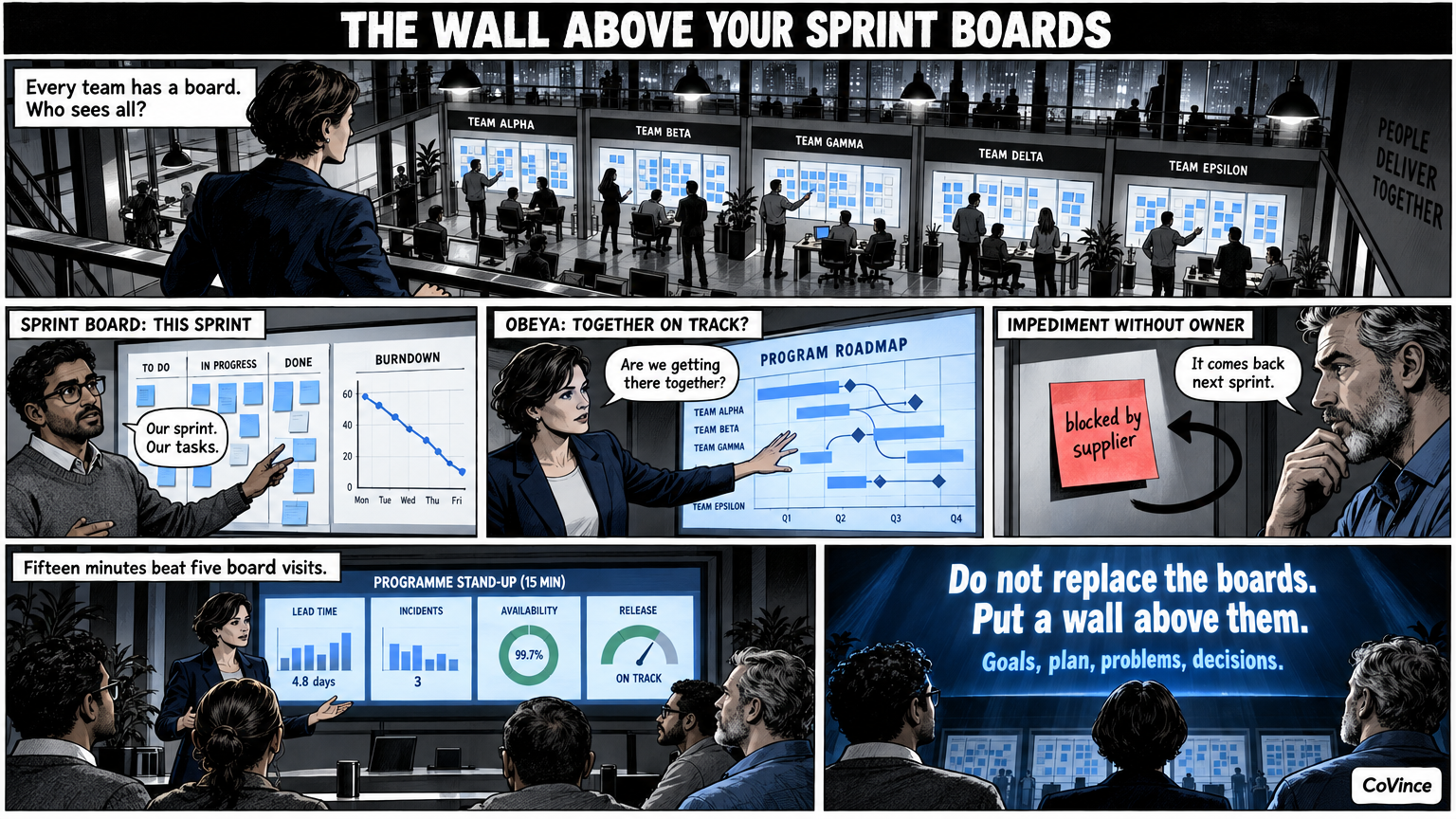
In an agile IT organisation every team already has a board. An Obeya is the wall above it: portfolio, roadmap, risks and dependencies of all teams in one place. That way you see in fifteen minutes whether the teams are on track together, instead of opening each board separately.
An Obeya is not a second Scrum board
The sprint board answers: what are we doing this sprint? The Obeya answers: are we getting together to where we need to be? Those are different questions, with a different audience. A scrum master looks at the sprint board; a programme manager, product owner and steering group look at the wall. You can read the difference between the two in detail in Obeya, Kanban or Scrum board?.
So you do not have to replace the boards. The Obeya sits above them and summarises what the teams do, in the four walls you know: goals and KPIs, plan and milestones, problems and actions, decisions and risks.
What hangs in an IT Obeya
- Goals and KPIs: the goals of the quarter or the release, and the numbers that go with them, such as lead time, the number of open incidents or availability. Every measurement with a target and a colour.
- Plan and milestones: the roadmap, the releases and the dependencies between teams. In CoVince’s Control Room there are tiles for roadmap and scrum.
- Problems and actions: what blocks a team, and who has the action. An impediment without an owner is a problem that comes back.
- Decisions and risks: architecture choices, technical debt that can hit a release, dependencies on suppliers.
PI planning and big-room planning
In frameworks with planning across several teams, such as PI planning in SAFe, teams meet for a day or two to plan the coming period. The wall is the heart of it: the goals per team, the dependencies and the risks. That is in effect a temporary Obeya.
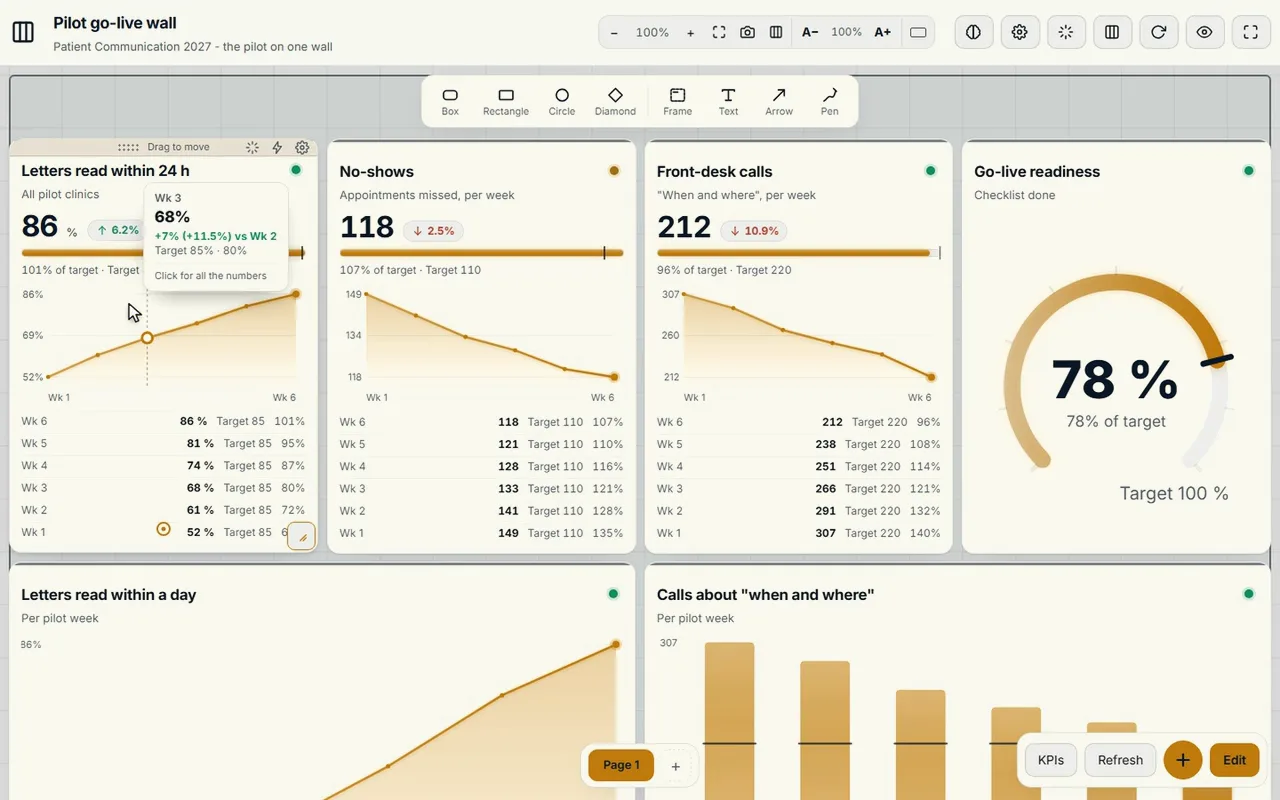
Digitally that has advantages. CoVince’s canvas is an infinite board with sticky notes, shapes and arrows that teams work on at the same time. Teams at different locations plan on the same wall and see each other’s dependencies appear. The conversation runs via the built-in video, and you show the board in the call.
After the planning the wall stays up. The agreements of the planning thus become the red and green tiles of the coming weeks, instead of a photo in a presentation.
The rhythm above the sprints
- Daily or a few times a week, fifteen minutes: scrum of scrums, but in front of the wall. What is red, who picks it up?
- Per sprint or per month: walk the wall together: progress, risks and decisions.
- Per period: recalibrate goals and KPIs. Are we still steering on the right things?
The Control Room shows at the top how many numbers are behind, at risk or on track, and how many actions are overdue. The stand-up starts with what needs attention.
Actions belong with the number
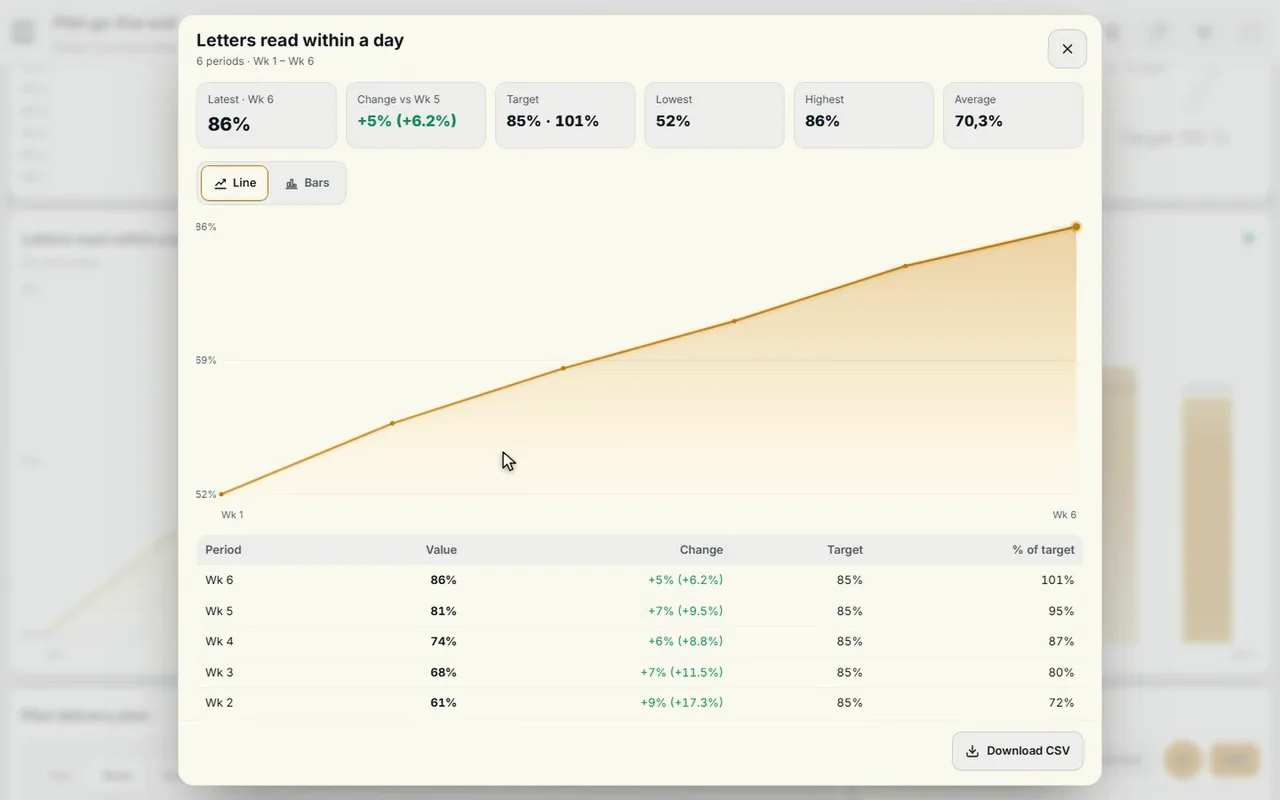
The danger of an IT dashboard is that it is beautiful and nothing follows from it. In CoVince you tap a chart and see which action is attached to it. Every action has an owner and a date. What comes out of the stand-up you work out further on a canvas, in a document or in a spreadsheet, in the same journey.
A CrewMate that knows the numbers
A CrewMate is an AI colleague that knows the journey and the board. You can ask it what is on the wall, out loud and hands-free too. It proposes, and you decide what goes on the wall. A chart from a sentence such as ‘intake per month against the target’ only uses columns that really are in your data.
How to start without replacing everything
- Leave your team boards where they are. Pick five to eight numbers that together show the health of the programme.
- Put the roadmap and the dependencies on a wall.
- Attach an action with owner and date to every red tile.
- Hold a fifteen-minute stand-up in front of the wall, and let the team write along.
For the list of walls see The five Obeya walls. For choosing a tool see Obeya software: what to look for.
Three things that often go wrong in IT organisations
The Obeya becomes a third tool next to Jira and a wiki. If the team has to retype the numbers and the roadmap, the wall is quickly outdated. Take what you can from a connection or a CSV, and only type what is nowhere else.
Everything becomes a KPI. Velocity, the number of tickets, the number of commits: not every number steers a decision. Choose numbers the team can influence and that say something about the quarter’s goal.
The stand-up becomes a status meeting. Everyone tells what they have done and nobody picks anything up. Start with what is red and end with actions that have an owner and a date.
Frequently asked questions
Does an Obeya replace the Scrum board?
No. The sprint board stays with the team. The Obeya sits above it and shows whether the teams are on track together: goals, roadmap, risks and dependencies.
Does PI planning fit in a digital Obeya?
Yes. Teams plan on the same canvas, even when they are at different locations, and the wall stays up after the planning with the agreements.
Which KPIs belong in an IT Obeya?
For example lead time, the number of open incidents or availability, depending on what you steer. Keep it to five to eight numbers, each with a target and an owner.
Can it also be done remotely?
Yes. A digital Obeya shows everyone the same live wall, and video calling is part of CoVince itself next to the board.
What does the CrewMate do in an IT team?
It reads the board and answers questions about the numbers, out loud too. It proposes, and you decide what goes on the wall.