
Obeya software compared: the complete feature list
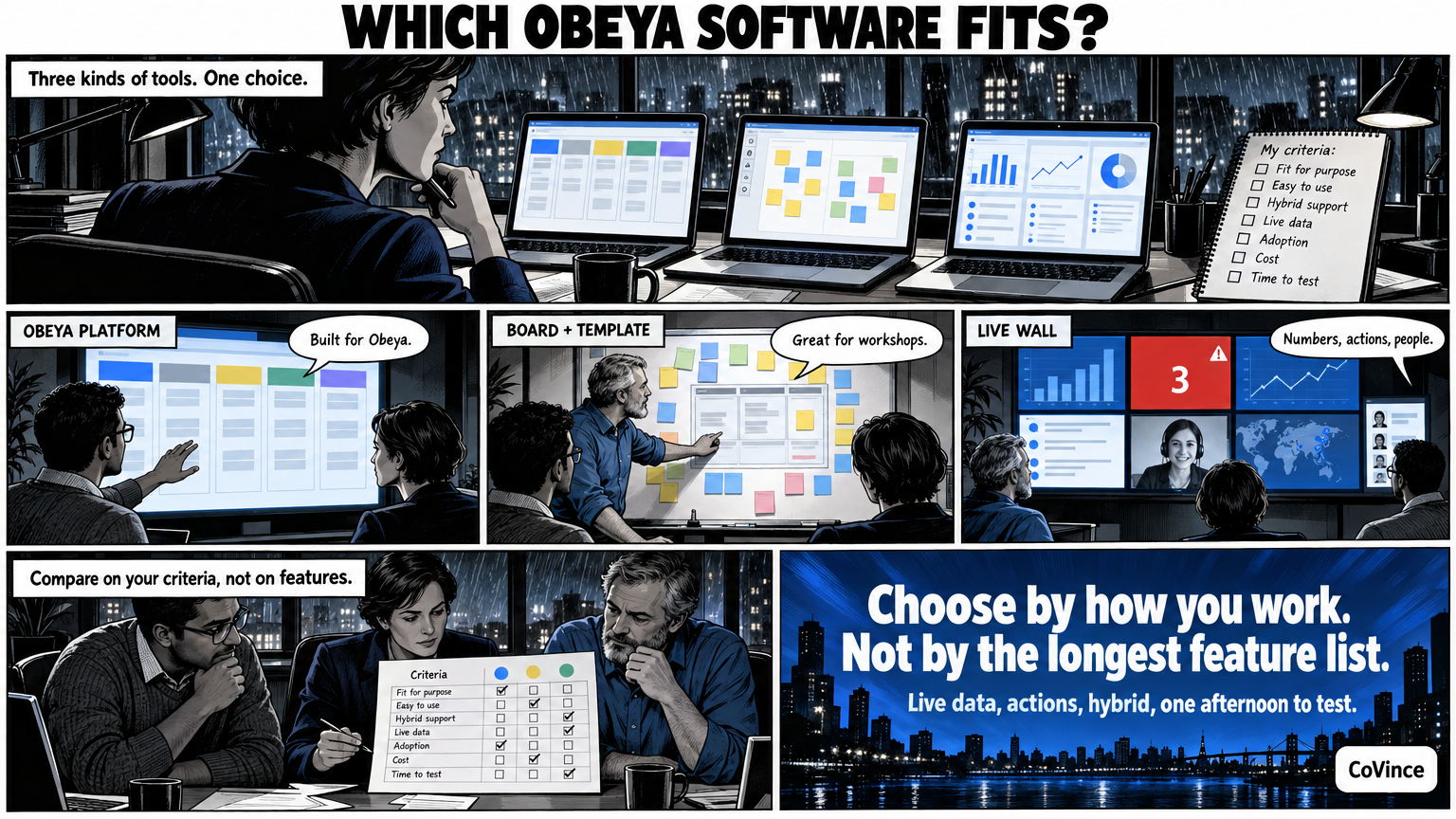
Which Obeya software fits? Do not compare on brand name, but on what your team does with it every week. Below is a feature list of more than fifty rows: CoVince, iObeya, Miro, Klaxoon and Microsoft Teams with Power BI, side by side. Every cell comes from the vendor's own public pages, read on 9 November 2026. Where we did not find something we say so, and we never write "no" unless the vendor says it.
Why compare on functions instead of brand?
A brand name does not tell you what you need at the wall on a Wednesday morning. A team with a red KPI wants to know who owns the action, a remote colleague wants to see the same wall, and a new colleague needs to learn how the process works. Those are functions, not brands.
That is why the comparison is a list of functions: walls, KPIs, roll-ups, actions, communication, video calling, learning modules, AI, documents, integrations, hybrid working, security and the pricing model. The five columns are not a ranking. They are also not five of the same kind of product: iObeya is an Obeya platform, Miro and Klaxoon are board tools, Teams with Power BI is a combination of two Microsoft products, and CoVince is a work platform with a Control Room.
The feature list (57 features)
Filter by category, or see everything. On a phone the table scrolls inside its own box; the first column stays in place.
- Yes
- Partly
- Via integration. Via integration or combination
- Not found. Not found on the vendor's site
- Not verified. Not verified by us
We never write "no" for a competitor unless the vendor itself says something is not possible. "Not found" means: we did not find it on the public pages we read. It may well exist. Check with the vendor what applies now.
Overview per category
| CoVince | iObeya | Miro | Klaxoon | T+PBI | |
|---|---|---|---|---|---|
The bar counts only what we found: Yes counts 1, Partly or via integration counts 0.5, the rest 0. It says nothing about quality or about what you need. Note that we are CoVince, and the list is partly built around our own functions, especially learning modules. Click a category to show only that one.
| Function | CoVince | iObeya | Miro | Klaxoon | Teams + Power BI |
|---|---|---|---|---|---|
| Live Obeya wall with tiles1Miro and Klaxoon are free-form boards on which you set up an Obeya (Miro via the Agile Walls app); Teams and Power BI are a combination. | |||||
| Wall across 1, 3 or 9 screens | |||||
| Templates for daily management and Obeya2iObeya names templates for daily management; Miro has dynamic templates via Agile Walls; Klaxoon names ready-made templates (SQCDP in an earlier reading). CoVince: templates per organisation. | |||||
| Five walls: goals, KPIs, plan, problems, actions | |||||
| Live tiles with numbers from sources3iObeya: "live KPIs" and "live data integration" (FAQ). Miro and Klaxoon: via apps and integrations. Teams: a Power BI tab with a report or scorecard. | |||||
| Tiered walls (team, department, company)4iObeya names a "Network of Obeya Rooms" and tiered rooms. CoVince: each wall belongs to a journey with its own rights; a fixed team-department-company tier structure is not a separate feature. | |||||
| Show KPIs on the wall | |||||
| Target, warning threshold and status per KPI5CoVince: target value, warning threshold in % and status (on track, at risk, behind, no data) per KPI. We did not find this described at the other vendors; with Teams + Power BI it runs through Power BI scorecards. | |||||
| Trend and history per day, week, month, quarter, year | |||||
| Manual KPI with a reminder to the owner | |||||
| KPI from CSV or source with automatic refresh6iObeya names CSV import and export and a Power Automate connector. CoVince: also interval or daily refresh (minimum 5 minutes). | |||||
| A red KPI leads to the linked action7CoVince shows target, sub-KPIs, actions and tiles together per KPI. iObeya names action management next to live KPIs but does not describe the link. | |||||
| Alert on breach (mail, in-app, workflow) | |||||
| KPI status rolls up from sub-KPIs (worst counts) | |||||
| Series sum, average, min, max, count, % with formula8At CoVince this works inside a tile on connected sources. With Teams + Power BI it happens in the Power BI model. | |||||
| Data steps: filter, group, join, pivot8At CoVince this works inside a tile on connected sources. With Teams + Power BI it happens in the Power BI model. | |||||
| Map drill-down with SUM, AVERAGE or WORST | |||||
| Roll up the same KPI from team walls to programme or portfolio9Honestly: automatically summing the same KPI across team walls to programme is not yet available in CoVince; today we calculate it in the source, for example Power BI. This feature is in development. The other vendors do not describe it on their sites. | |||||
| KPI calculated from other KPIs, weighted average10Honestly: a KPI that CoVince itself calculates from other KPIs, and weighted averages, are in development and not yet available. Today it runs through the source, for example Power BI. | |||||
| Action with owner and due date11iObeya names action management; Miro and Klaxoon have cards or a Jira link; with Teams it runs through Planner or an app (the Teams documentation mentions the Planner link). | |||||
| Action next to the chart and on the timeline | |||||
| Late actions count in the KPI status | |||||
| Read Jira issues or Planner tasks in as actions12CoVince reads the issues of a Jira project as actions in a journey (which can be taken over as real CoVince actions), with the latest comments on the timeline and attachments in Community Files. Asana works the same way, and Teams delivers Planner tasks as actions, channel conversations and files. Jira is also a KPI source, and Jira and Confluence can be reached through the CrewMate. At CoVince, Azure DevOps is a data source for KPIs, not an actions layer. Klaxoon names Jira from Starter, without saying what is synchronised. Miro: Jira and Azure DevOps from Business. iObeya: Jira and Azure DevOps. Teams: Planner (per the Teams documentation). | |||||
| Two-way sync (write back to Jira or Azure DevOps)13CoVince reads from Jira and writes back: when an admin switches it on per connection, status (close and reopen through Jira's own workflow), assignee, due date and comments of taken-over actions go back to the Jira issue. Title and description stay Jira's; if a field was changed in Jira in the meantime, Jira wins. At CoVince, Azure DevOps is a KPI source, without write-back yet. iObeya names two-way Jira and Azure DevOps on its own site. For Miro, Klaxoon and Teams + Power BI we did not check whether the connection writes back. | |||||
| Chat and threads per journey or team | |||||
| Reactions and notifications on a timeline | |||||
| Mail and calendar in the same platform | |||||
| Built-in video calling14Miro: video calls from the Starter plan. Teams: meetings. Klaxoon: a built-in video service was named in 2021 press; we did not check whether that holds today. iObeya: not found; a customer story mentions Teams alongside. | |||||
| Video calling on the wall itself | |||||
| Guests without an account15CoVince: according to our whitepaper guests join without an account; we did not re-check that in the code for this article. Teams has guests and external users. | |||||
| Recording and minutes with action list | |||||
| Micro-learning with swipeslides (36 question types)16Klaxoon names training and interactive surveys ("dynamic training"); we found no learning modules with progress. iObeya has an Academy, but it teaches the tool, not your staff. CoVince: 36 standard types. | |||||
| Build a learning module with AI from a document or topic | |||||
| Practising with AI role play (CrewMate, voice) | |||||
| Scenario games for a team with roles | |||||
| Quiz and survey | |||||
| Certificates, points, leaderboard and growth paths | |||||
| Learning journeys with steps, progress and roles | |||||
| VR and simulation17CoVince has VR in a separate Unity app next to the web app, with 3D scenes that also run in the browser or on a headset. A 3D room scan with questions is also part of the web learning modules. We did not check which headsets are supported. We did not find this at the other vendors. | |||||
| AI that answers questions about the board's figures18Miro: AI credits and Sidekicks; Klaxoon: AI that summarises, classifies and translates whiteboards; Teams: Copilot is a separate licence. None of them names an AI that answers questions about the KPI figures of an Obeya wall. CoVince: the CrewMate knows the board. | |||||
| Voice, hands-free | |||||
| AI agents, workflows or MCP19Miro: AI workflows and agents from Business, plus MCP calls. Klaxoon: MCP in paid plans. CoVince: the CrewMate builds workflows. | |||||
| Documents and spreadsheets in the platform | |||||
| Whiteboard or canvas | |||||
| Ready-made connections (e.g. Power BI, SAP, ServiceNow)20CoVince has source templates for Power BI, Tableau, SAP, ServiceNow, SharePoint, Jira, Azure DevOps, Salesforce and HubSpot, among others. Miro names 250+ apps; Klaxoon names Microsoft Teams, Jira, Wrike, Office, OneDrive and Google; iObeya names Jira, Azure DevOps, Power Automate, CSV and a REST API (Enterprise). | |||||
| Own source: REST/JSON, CSV, SharePoint, Google Sheets, webhook21Klaxoon: an API with SCIM and audit log in the Enterprise plan; iObeya: REST API in Enterprise. Teams + Power BI: via Power BI data sources. | |||||
| Write back to the source | |||||
| Remote colleagues see the same wall live | |||||
| Physical room with LED or projector wall22In 2021 Klaxoon sold touch boards and a meeting-room capsule (press reports); we did not check whether that range still exists. | |||||
| Mobile app or phone use23Miro lists iOS and Android apps in its footer, without a plan split. Teams: mobile tabs (Power BI documentation). CoVince: phone use through the web app. | |||||
| Voice notes, also offline | |||||
| Roles and rights per board, tile and KPI24CoVince: roles at organisation and journey level, visibility per board and per tile; someone without read access sees "not authorised". iObeya names an admin interface for users and rooms; Miro an Enterprise Guard (add-on); Klaxoon domain recognition and advanced security; Teams and Power BI workspace roles. | |||||
| Single sign-on25CoVince: its own OIDC sign-in with organisation SSO federation and MFA (e-mail code, TOTP, passkey, phone). iObeya: SAML 2.0 and LDAPS. Miro: SAML from Business. Klaxoon: SAML 2.0 in Enterprise; Microsoft, Google, Okta and Entra ID named. Teams: Entra ID. | |||||
| EU hosting or choice of region26Miro: EU data residency in all plans (pricing page). iObeya: you choose the AWS region; the EU is not named specifically. Klaxoon: data residency, the page contradicts itself on which plan. CoVince: hosted in the EU at OVHcloud in France, with its own database; video calls via servers in France and Germany. | |||||
| ISO 27001 stated by the vendor27iObeya names ISO/IEC 27001:2013 on its own security page. Klaxoon names certifications of its hosting providers. CoVince is ISO 27001 certified. For the other vendors we checked no certificate. | |||||
| Own environment or on-premise28iObeya: on-premise or private cloud possible (its own security page). Klaxoon: "self-hosted on demand" in the Enterprise plan. | |||||
| Languages of the product29iObeya: the site is in English, French and German; we did not find the product languages. Miro: not specified on the pricing page. Klaxoon: only AI translation named. CoVince: multilingual (this site: five languages). | |||||
No functions found. Change the search or the filters.
Tap a cell for an explanation.
Notes on the cells
- Miro and Klaxoon are free-form boards on which you set up an Obeya (Miro via the Agile Walls app); Teams and Power BI are a combination.
- iObeya names templates for daily management; Miro has dynamic templates via Agile Walls; Klaxoon names ready-made templates (SQCDP in an earlier reading). CoVince: templates per organisation.
- iObeya: "live KPIs" and "live data integration" (FAQ). Miro and Klaxoon: via apps and integrations. Teams: a Power BI tab with a report or scorecard.
- iObeya names a "Network of Obeya Rooms" and tiered rooms. CoVince: each wall belongs to a journey with its own rights; a fixed team-department-company tier structure is not a separate feature.
- CoVince: target value, warning threshold in % and status (on track, at risk, behind, no data) per KPI. We did not find this described at the other vendors; with Teams + Power BI it runs through Power BI scorecards.
- iObeya names CSV import and export and a Power Automate connector. CoVince: also interval or daily refresh (minimum 5 minutes).
- CoVince shows target, sub-KPIs, actions and tiles together per KPI. iObeya names action management next to live KPIs but does not describe the link.
- At CoVince this works inside a tile on connected sources. With Teams + Power BI it happens in the Power BI model.
- Honestly: automatically summing the same KPI across team walls to programme is not yet available in CoVince; today we calculate it in the source, for example Power BI. This feature is in development. The other vendors do not describe it on their sites.
- Honestly: a KPI that CoVince itself calculates from other KPIs, and weighted averages, are in development and not yet available. Today it runs through the source, for example Power BI.
- iObeya names action management; Miro and Klaxoon have cards or a Jira link; with Teams it runs through Planner or an app (the Teams documentation mentions the Planner link).
- CoVince reads the issues of a Jira project as actions in a journey (which can be taken over as real CoVince actions), with the latest comments on the timeline and attachments in Community Files. Asana works the same way, and Teams delivers Planner tasks as actions, channel conversations and files. Jira is also a KPI source, and Jira and Confluence can be reached through the CrewMate. At CoVince, Azure DevOps is a data source for KPIs, not an actions layer. Klaxoon names Jira from Starter, without saying what is synchronised. Miro: Jira and Azure DevOps from Business. iObeya: Jira and Azure DevOps. Teams: Planner (per the Teams documentation).
- CoVince reads from Jira and writes back: when an admin switches it on per connection, status (close and reopen through Jira's own workflow), assignee, due date and comments of taken-over actions go back to the Jira issue. Title and description stay Jira's; if a field was changed in Jira in the meantime, Jira wins. At CoVince, Azure DevOps is a KPI source, without write-back yet. iObeya names two-way Jira and Azure DevOps on its own site. For Miro, Klaxoon and Teams + Power BI we did not check whether the connection writes back.
- Miro: video calls from the Starter plan. Teams: meetings. Klaxoon: a built-in video service was named in 2021 press; we did not check whether that holds today. iObeya: not found; a customer story mentions Teams alongside.
- CoVince: according to our whitepaper guests join without an account; we did not re-check that in the code for this article. Teams has guests and external users.
- Klaxoon names training and interactive surveys ("dynamic training"); we found no learning modules with progress. iObeya has an Academy, but it teaches the tool, not your staff. CoVince: 36 standard types.
- CoVince has VR in a separate Unity app next to the web app, with 3D scenes that also run in the browser or on a headset. A 3D room scan with questions is also part of the web learning modules. We did not check which headsets are supported. We did not find this at the other vendors.
- Miro: AI credits and Sidekicks; Klaxoon: AI that summarises, classifies and translates whiteboards; Teams: Copilot is a separate licence. None of them names an AI that answers questions about the KPI figures of an Obeya wall. CoVince: the CrewMate knows the board.
- Miro: AI workflows and agents from Business, plus MCP calls. Klaxoon: MCP in paid plans. CoVince: the CrewMate builds workflows.
- CoVince has source templates for Power BI, Tableau, SAP, ServiceNow, SharePoint, Jira, Azure DevOps, Salesforce and HubSpot, among others. Miro names 250+ apps; Klaxoon names Microsoft Teams, Jira, Wrike, Office, OneDrive and Google; iObeya names Jira, Azure DevOps, Power Automate, CSV and a REST API (Enterprise).
- Klaxoon: an API with SCIM and audit log in the Enterprise plan; iObeya: REST API in Enterprise. Teams + Power BI: via Power BI data sources.
- In 2021 Klaxoon sold touch boards and a meeting-room capsule (press reports); we did not check whether that range still exists.
- Miro lists iOS and Android apps in its footer, without a plan split. Teams: mobile tabs (Power BI documentation). CoVince: phone use through the web app.
- CoVince: roles at organisation and journey level, visibility per board and per tile; someone without read access sees "not authorised". iObeya names an admin interface for users and rooms; Miro an Enterprise Guard (add-on); Klaxoon domain recognition and advanced security; Teams and Power BI workspace roles.
- CoVince: its own OIDC sign-in with organisation SSO federation and MFA (e-mail code, TOTP, passkey, phone). iObeya: SAML 2.0 and LDAPS. Miro: SAML from Business. Klaxoon: SAML 2.0 in Enterprise; Microsoft, Google, Okta and Entra ID named. Teams: Entra ID.
- Miro: EU data residency in all plans (pricing page). iObeya: you choose the AWS region; the EU is not named specifically. Klaxoon: data residency, the page contradicts itself on which plan. CoVince: hosted in the EU at OVHcloud in France, with its own database; video calls via servers in France and Germany.
- iObeya names ISO/IEC 27001:2013 on its own security page. Klaxoon names certifications of its hosting providers. CoVince is ISO 27001 certified. For the other vendors we checked no certificate.
- iObeya: on-premise or private cloud possible (its own security page). Klaxoon: "self-hosted on demand" in the Enterprise plan.
- iObeya: the site is in English, French and German; we did not find the product languages. Miro: not specified on the pricing page. Klaxoon: only AI translation named. CoVince: multilingual (this site: five languages).
Per category: a fair analysis
Obeya walls and boards
iObeya is the specialist here: rooms that follow the structure of your organisation, in tiers and linked in a network. Miro and Klaxoon give you a free-form board on which you build an Obeya yourself, which is nice if your team already works there. CoVince is the only one in this list for which we found a single wall across one, three or nine screens with live tiles; a fixed tier structure from team to company is stronger at iObeya.
KPIs and roll-ups
KPIs are where the vendors differ most. CoVince describes target, warning threshold, status and history per period, and lets a red KPI point to its actions. Summing the same KPI across team walls to a programme is not something CoVince does itself yet; today that runs through the source, for example Power BI, and it is in development. If you need a lot of calculation and modelling, Power BI itself is stronger than any of the boards.
Actions and follow-up
They all have an action with owner and due date in some form. The difference is the connection: at CoVince the action sits next to the chart and a late action counts in the KPI status. iObeya, Miro and Klaxoon sync with Jira, which is strong if your development work already lives there.
Communication and video calls
Here Teams is the established standard for chat and meetings, and Miro has video calls in the board. CoVince has chat, timeline, mail, calendar and video calling in the same platform as the wall, with minutes and an action list. In what we read, iObeya has no built-in video calling; customers use another program alongside. If you already live in Teams you get this with it; if you want the wall itself to be the conversation, look at the other columns.
Learning modules
This is the category where the list is most lopsided, and we say so openly. CoVince has micro-learning with swipeslides, practice with an AI role play, scenario games for a team, certificates and learning journeys, because next to the wall it is a learning platform. At the other vendors we did not find this; Klaxoon names training and surveys, and iObeya has an Academy that explains the tool. If you have no learning need, this category does not count for you. VR lives in a separate Unity app.
AI assistant
Miro has the most AI options in our sources: credits, workflows, agents and MCP. Klaxoon summarises and translates whiteboards. Teams has Copilot as a separate licence. CoVince's CrewMate answers questions about the board's figures and works by voice. That is a different kind of AI from a whiteboard summary; choose on what you want to do with it.
Documents, whiteboard and integrations
Miro, Klaxoon and Teams have a free-form whiteboard at their core; CoVince has a canvas next to documents and spreadsheets. On integrations Miro names the most apps (250+). CoVince has source templates for Power BI, SAP and ServiceNow, among others, reads Jira issues, Asana tasks and Teams/Planner as actions, timeline and files in a journey, and can write actions back to an own REST source; with Jira it works both ways (status, assignee, due date and comments go back). iObeya is strong in two-way Jira, Azure DevOps and a REST API in Enterprise. If you want data from existing systems on a wall, check which of your systems the vendor names.
Hybrid, room, security and pricing model
On security, iObeya (ISO 27001, SAML, on-premise possible) and Miro (EU data residency, SAML) are the best documented on their own pages. CoVince has its own sign-in with organisation SSO and MFA, rights per board and per tile, and encrypted connection secrets; CoVince is ISO 27001 certified and hosted in the EU (OVHcloud, France). A physical room with an LED wall or three and nine screens is, in our sources, described only at CoVince. We name no prices: ask each vendor for a proposal.
When do you choose what?
- CoVince if you want wall, plan, actions, chat, video calling and learning in one environment, on one, three or nine screens.
- iObeya if you want a specialised lean platform with tiered rooms, many templates and strong Jira or Azure DevOps integrations.
- Miro if your team already works in Miro and wants an Obeya on a free-form board, with the Agile Walls app and AI options.
- Klaxoon if workshops, surveys and a visual board are the core and the Obeya is one of several uses.
- Teams with Power BI if you already work in Microsoft 365 and your figures are in Power BI: a report as a tab in your team channel is the smallest step.
Be honest about what CoVince is not: not a replacement for Power BI as a calculation model, and automatic roll-up of a KPI across walls is still in development. It is there for the steering conversation of a team or programme.
Sources and date
All competitor cells come from these public pages, read on 9 November 2026. Pages can change; check with the vendor what applies now. Sources marked "via search result" we read as a snippet, not as a whole page; the cells relying on them are marked with care. CoVince cells come from our own product code and documentation.
- iObeya, home (rooms, Control Tower, Academy, FAQ licence per room): https://www.iobeya.com/ (9-11-2026)
- iObeya, integrations (Jira, Azure DevOps, Power Automate, CSV, REST API): https://iobeya.com/features/integrations (9-11-2026)
- iObeya, security (ISO 27001, AWS region, SAML, LDAPS, on-premise): https://iobeya.com/enterprise-grade-security (9-11-2026)
- iObeya, pricing (licensed per room): https://www.iobeya.com/pricing (9-11-2026)
- Miro, pricing and plans (video, AI, integrations, SAML, EU data residency): https://miro.com/pricing/ (9-11-2026)
- Miro, Obeya room with Agile Walls (via search result): https://miro.com/pt/obeya-room/ (9-11-2026)
- Miro, Agile Walls marketplace app (via search result): https://miro.com/marketplace/agilewalls (9-11-2026)
- Klaxoon, home (whiteboard, AI, integrations, surveys, SSO): https://www.klaxoon.com/ (9-11-2026)
- Klaxoon, pricing (SAML, data residency, API, MCP): https://www.klaxoon.com/pricing (9-11-2026)
- Klaxoon, press 2021 on meeting-room hardware (dated, via search result): https://techcrunch.com/2021/06/15/klaxoon-introduces-whiteboard-focused-conference-room-for-hybrid-work (9-11-2026)
- Microsoft Learn, Embed Power BI reports in Teams (tab, scorecards, conversation, mobile): https://learn.microsoft.com/en-us/power-bi/collaborate-share/office-integration/service-embed-report-microsoft-teams (9-11-2026)
- Microsoft Learn, Teams overview (meetings, guests, SharePoint, Planner, Power BI): https://learn.microsoft.com/en-us/microsoftteams/teams-overview (9-11-2026)
- Microsoft Support, Whiteboard with external participants (via search result): https://support.microsoft.com/article/5176f52b-e345-4d48-bbe1-793a95420826 (9-11-2026)
Frequently asked questions
Which functions matter most in Obeya software?
Live figures with target and status, actions with owner and due date next to the chart, remote colleagues who see the same wall, and a rhythm of stand-ups. After that come communication, learning and AI. Use the feature list above and tick what weighs heavily for you.
What is the difference between iObeya, Miro, Klaxoon and CoVince?
iObeya is an Obeya platform with tiered rooms. Miro and Klaxoon are free-form board tools on which you set up an Obeya. CoVince is a work platform with a Control Room of tiles, chat, video calling, actions and learning modules. Teams with Power BI is a combination of two Microsoft products.
Can CoVince sum KPIs from several team walls?
Not automatically yet. CoVince rolls up the status of sub-KPIs and can sum or average series from several sources, but summing a KPI across team walls to a programme runs through the source today, for example Power BI. A calculated KPI and a weighted average are in development.
Does the table say "no" when a vendor lacks something?
No, it says "Not found on the vendor's site". That means we did not find it on the public pages we read. Only when a vendor itself says something is not possible do we write that.
What does Obeya software cost?
We name no amounts. iObeya licenses per room, Miro and Klaxoon work with plans, and Teams and Power BI with licences through Microsoft. Ask each vendor for a proposal.