
Why nobody looks at the Obeya wall after three months
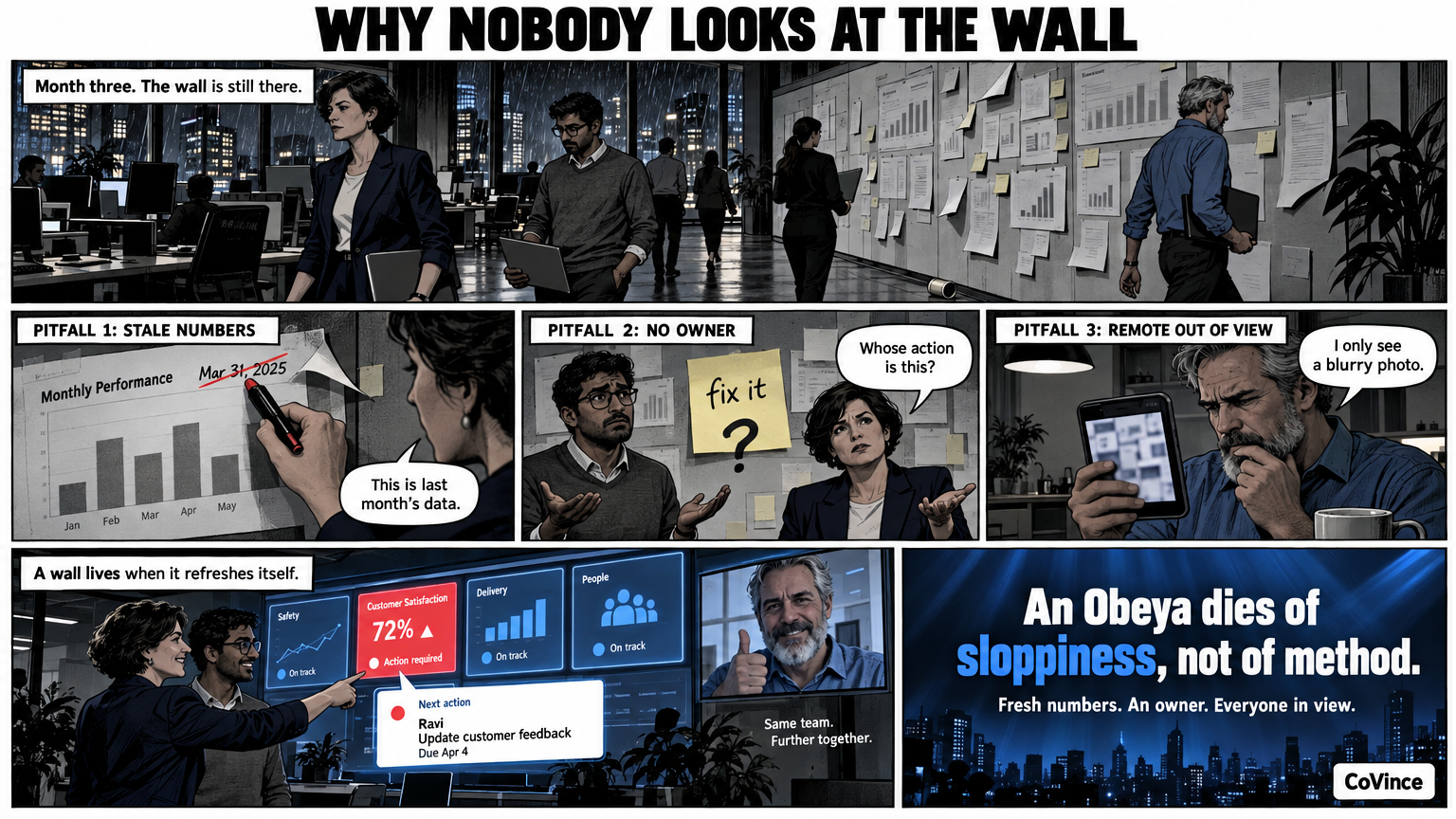
An Obeya rarely dies from the wrong method; it dies from sloppiness. After three months the prints are outdated, actions have no owner and half the team is out of view. Below are seven pitfalls, how to recognise them and what to do about them, with an honest word on what software does and does not solve.
The first weeks of an Obeya are easy. There is energy, the wall is new and the stand-up feels special. The real work starts after that. These are the seven pitfalls we see described most often, in an order that roughly follows the time in which they appear.
1. The numbers go stale
The paper Obeya has a built-in problem: a printed chart is out of date before the marker is dry. Someone has to renew the prints every week, and once that becomes too much work, nobody looks at the wall any more. A wall with old numbers is worse than no wall, because it creates trust that is not there.
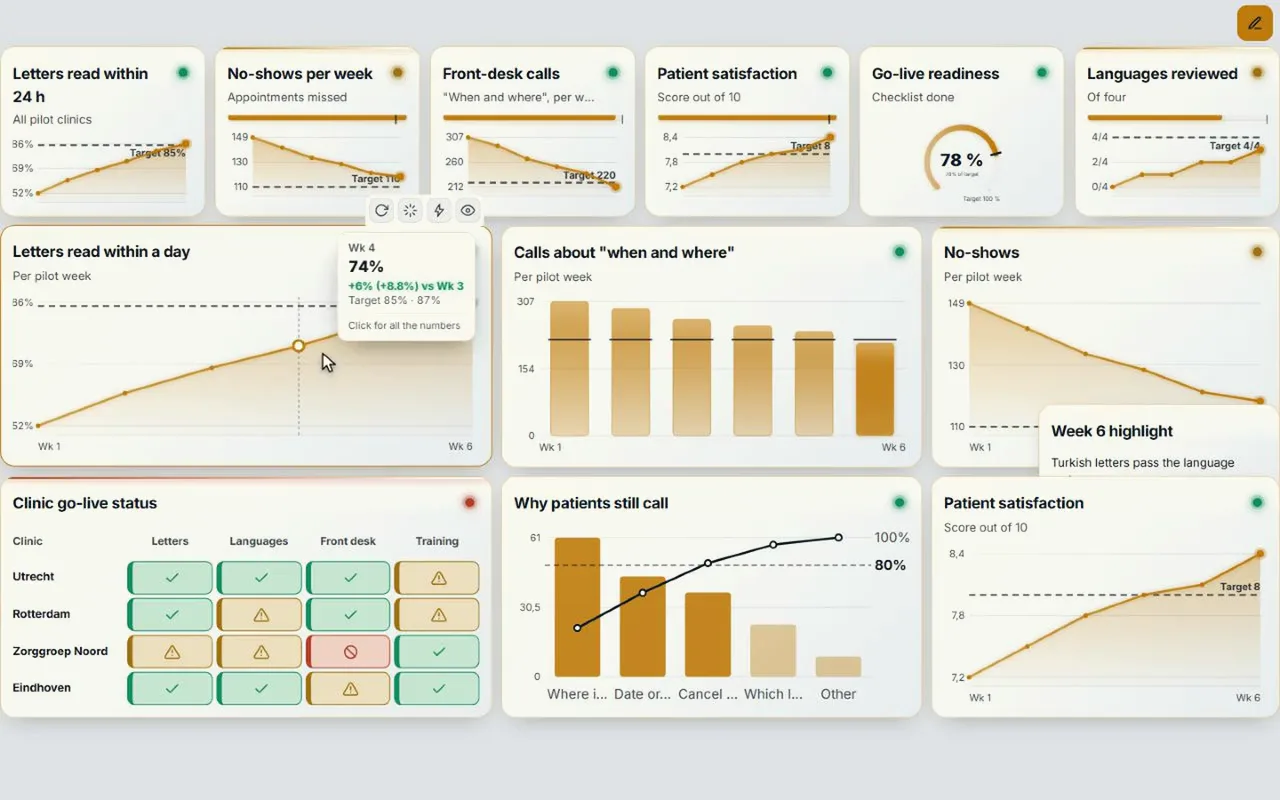
What helps: do not let a person maintain the numbers when it is not necessary. In a digital Obeya the numbers come from CoVince itself, from a CSV, from connected sources or are typed in, and the tiles refresh along with them. Also agree per KPI who keeps it up to date and how often.
2. Actions without an owner or date
A red number that is discussed in the stand-up and ends with “we should look into that sometime” achieves nothing. Two weeks later it is still there, and everyone has got used to it. That is the beginning of the end: the wall shows problems, but nothing happens.
What helps: every action gets an owner and a date before you move on to the next point. The facilitator guards that. In the next stand-up you first ask about yesterday’s actions. In CoVince the action hangs on the board it is about, and the actions that are overdue come back as a status on the wall.
3. Remote colleagues drop out of view
An Obeya only works for the people standing in the room. As soon as part of the team works from home or from another location, two conversations arise: the one in front of the wall and the one in the chat. The people on the other end do not see the wall and drop off. After three months only five people still come to the room and the whole programme is steering on something else.
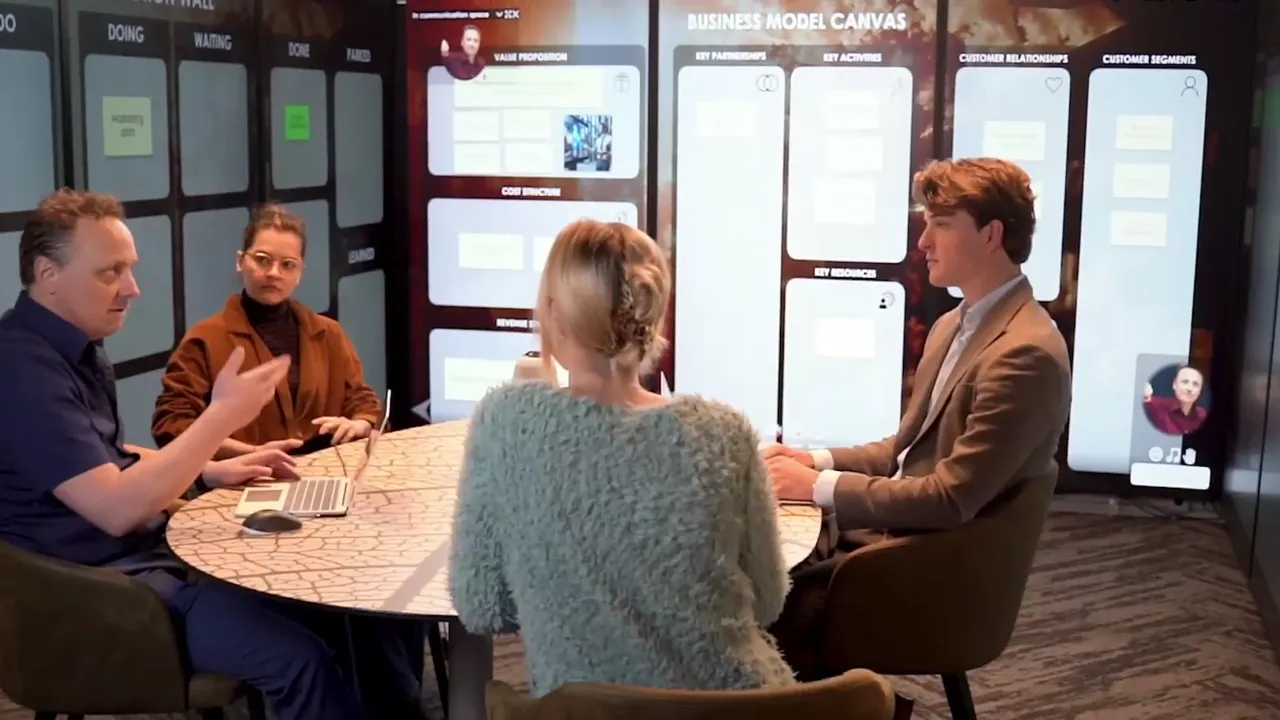
What helps: make the wall digital, so everyone sees the same live wall, and put video calling on the wall. In CoVince video calling sits next to the board: the remote colleague is on the wall, the board stays in the middle. Give the remote colleague a turn, and not only at the end. More on this in Hybrid Obeya.
4. Too many KPIs
The temptation is big to put everything you can measure on the wall. After a few months there are twenty tiles, half of them never red, and attention is everywhere and nowhere. If everything is important, nothing stands out.
What helps: pick a handful of KPIs the team can really steer on, each with a target and an owner. Take what never leads to a decision off the wall. Recalibrate the KPIs per period, not only when things go wrong. See also The five Obeya walls.
5. The wall turns into a presentation
Whoever builds the Obeya for the board builds a beautiful wall. Beautiful walls get looked at, not used. If the project lead holds the whole conversation and the team stands by watching, it is a presentation, and nobody comes voluntarily any more.
What helps: let the KPI owners tell for themselves what is going on, and rotate the role of facilitator. The wall is a workplace: something should change during the stand-up, an action that is added or closed.
6. The rhythm fades
The daily stand-up becomes twice a week, then once a week, and then only when there is something. Without a fixed rhythm there is no habit, and without a habit there is no Obeya. The weekly session on plan, risks and decisions is the first to disappear from the calendars.
What helps: put the rhythm in everyone’s calendar, at the same time, lasting fifteen minutes. Keep the stand-up strictly to what is red or changing. Make sure the wall is so accessible that a stand-up can happen on a laptop or on a screen in an ordinary meeting room: the lower the threshold, the longer the rhythm lasts. The agenda is in Obeya stand-up: agenda and rhythm.
7. Red is not safe
The deepest pitfall is not technical. If a team notices that reporting red causes trouble, the wall is green from that moment on. A green wall is a beautiful lie. An Obeya works when it is safe to put problems on the table early.
What helps: leadership. Respond to a red item with “what do you need?” and not with “why?”. Software can make problems visible, but it is up to the team whether they are also discussed.
A self-test
Look at your wall and answer honestly:
- When were the numbers last updated, and by whom?
- How many actions have an owner and a date that has not passed yet?
- Can everyone who belongs here see the wall, even when not in the room?
- How many KPIs have been red in the past month, and what happened to them?
- Who leads the conversation: one person or the team?
- Is the stand-up still in the calendars, and does everyone come?
Two or more answers you do not like? Then this is the moment to restart, not to quietly stop. Begin with one wall, one stand-up and action owners. The whole method is in What is Obeya? The complete guide.
Frequently asked questions
Why does our Obeya stop working after a few months?
Usually through creeping sloppiness: the numbers go stale, actions have no owner or date, the rhythm fades and remote colleagues drop out of view. The method itself is rarely the problem.
How do I stop the numbers from going stale?
Do not maintain them by hand when it is not necessary. In CoVince, numbers come from CoVince itself, from a CSV, from connected sources or are typed in; agree per KPI who keeps it up to date.
What do I do with actions that keep slipping?
Give every action an owner and a date, and in the next stand-up check yesterday’s actions first. An action that slips gets a new date or a new owner, not silently more time.
How do I involve remote colleagues in the Obeya?
Make the wall digital, so everyone sees the same live wall. In CoVince video calling sits next to the board, so the remote colleague is on the wall.
How many KPIs belong on the wall?
A handful the team can really steer on. Take what never leads to a decision off the wall and recalibrate the KPIs per period.