
Obeya in healthcare: one wall for hospital, ward and care chain
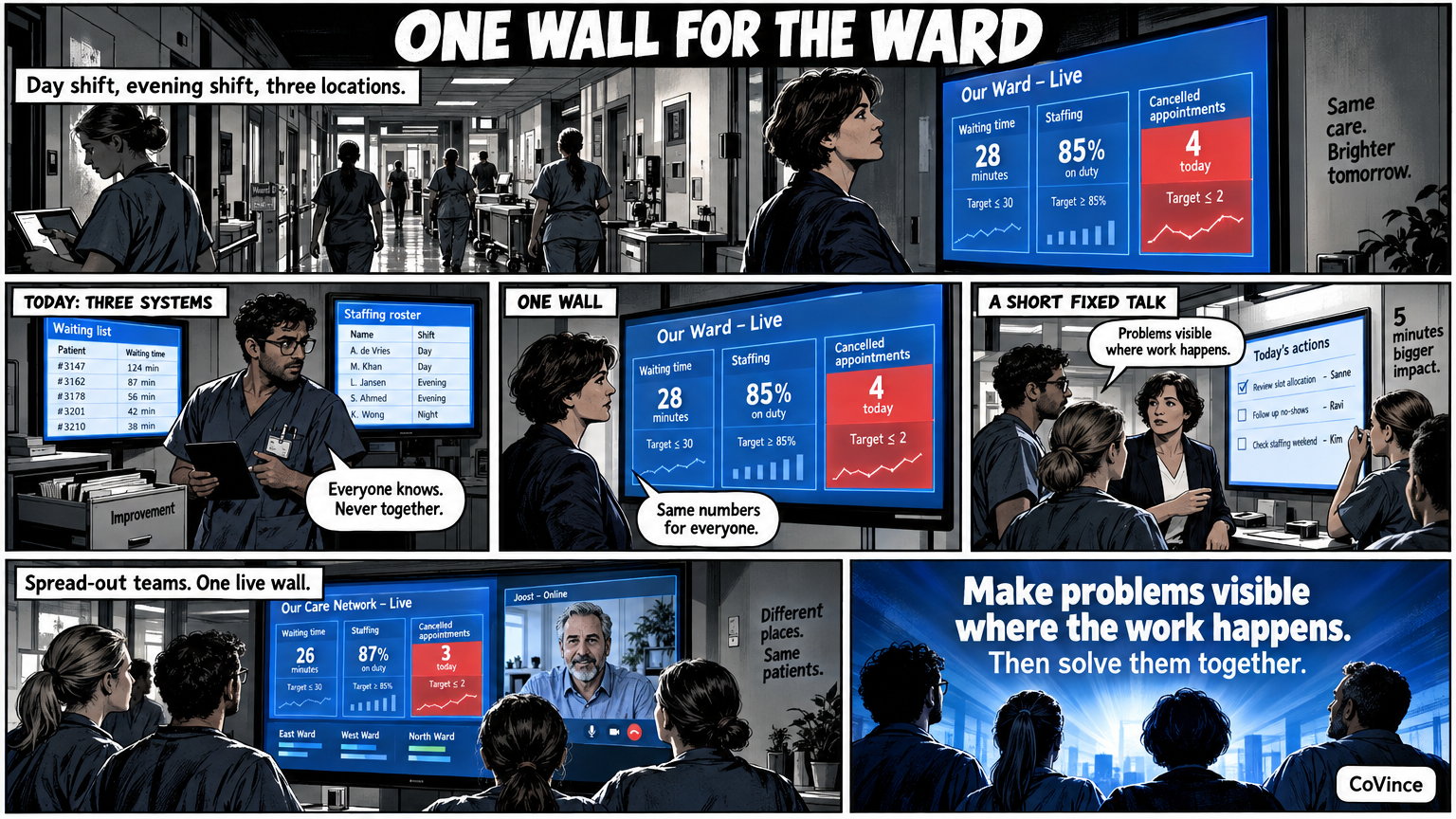
An Obeya in healthcare is a shared wall where the goals, numbers, problems and actions of a ward, a hospital or a care chain come together. It works because care teams work spread out: day shift, evening shift, several locations and colleagues who look along from home. With a digital Obeya they all see the same live wall.
Why healthcare wants an Obeya
In a hospital or a care organisation almost everyone knows what is wrong, but rarely at the same moment and in the same numbers. The waiting list is in one system, the staffing in another and the improvement actions in a project leader’s folder. An Obeya brings those three together in one place, and enforces a short, fixed discussion.
The idea comes from the lean method. It fits healthcare because the core of lean already lives there: making problems visible at the place where the work is done and solving them together. What makes healthcare hard is the reality of the roster. Not everyone can stand in the same room at nine o’clock.
What hangs on the wall
Start with the walls you see in every Obeya, and fill them with what suits your ward. A few examples of topics teams often choose, as a starting point and not as a norm:
- Goals and KPIs: for example waiting time, staffing, the number of cancelled appointments or the lead time of a pathway. Every measurement with a target and a colour.
- Plan and milestones: the introduction of a new way of working, a renovation or a new care pathway, with who picks up what.
- Problems and actions: what is not going well, and who does something about it this week. Every action an owner and a date.
- Decisions and risks: what has been decided, and what can still hit the planning.
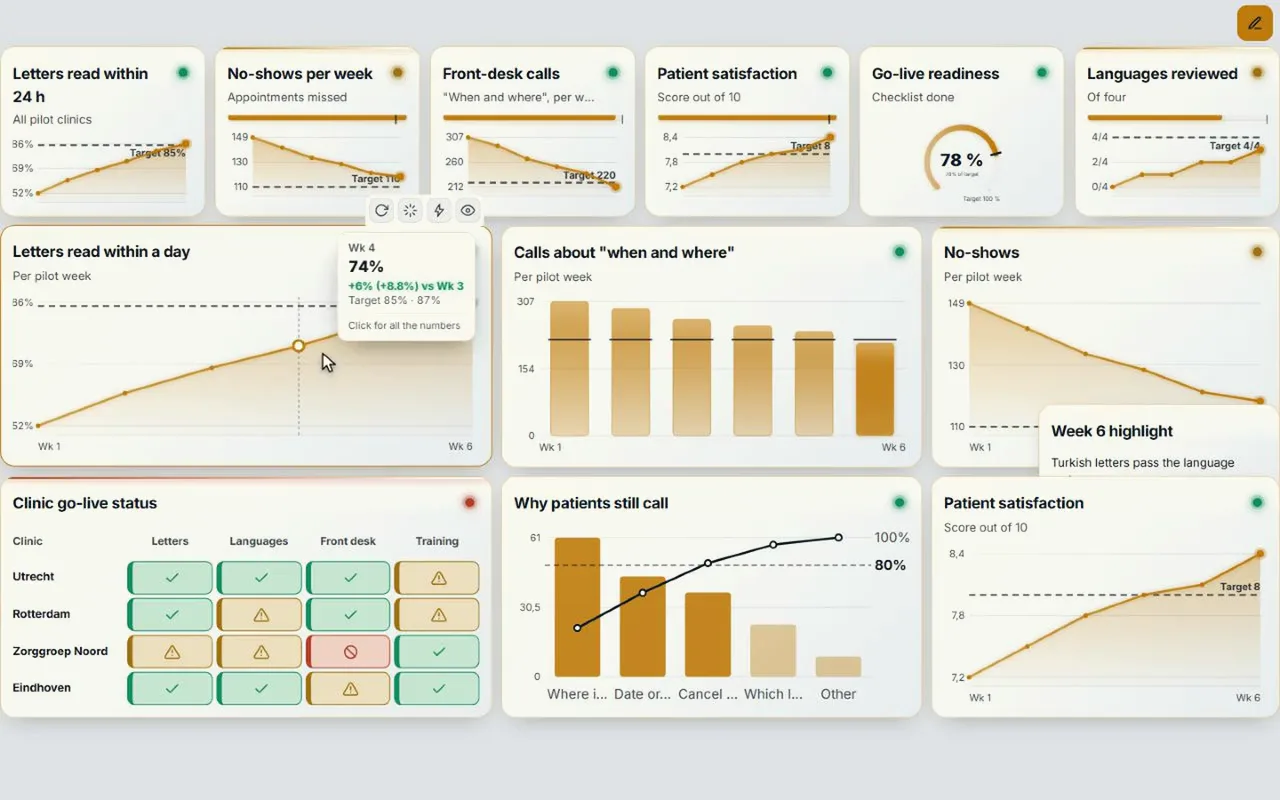
The screenshot shows what such a wall looks like: a status per location, and next to it where it goes wrong. All numbers above are demo data. What you put on it is up to the team.
The rhythm on a ward
An Obeya is not a poster but a rhythm. On a ward a short stand-up usually works, and it fits within a handover or a team meeting.
- Daily, fifteen minutes: what is red, who picks it up? You walk along the screens and do not linger at what is green.
- Weekly: walk the walls together: plan, risks and decisions.
- Per period: recalibrate goals and KPIs. Are we still steering on the right things?
In CoVince you see at the top of the board at a glance how many numbers are behind, at risk or on track, and how many actions are overdue. Tap one and you see only those tiles. So the stand-up starts with what needs attention. The details of agenda and order are in Obeya stand-up: agenda and rhythm.
Across wards and locations
The biggest gain is in chain and programme work: a care pathway that runs past the outpatient clinic, the ward, the pharmacy and home care. Each part has a story of its own, and without a shared wall the pathway exists nowhere as a whole.
With a digital Obeya the same wall hangs in several places. Whoever is at another location or works from home sees the same board and joins the conversation. Video calling is part of CoVince itself, next to the board, and you can show the board in the conversation. Everyone sees at once what changes. Guests join without an account, via a link with a waiting room.
What to watch for
Healthcare works with sensitive data, and a wall is there for everyone standing in the room. So put completely different data on a shared wall than in the patient file: counts, lead times, percentages and actions, no names of patients. Agree with your privacy officer what may go on the wall. That is an agreement within your organisation, and not a property of a tool.
Also make sure the wall does not tell the nice story. A wall that is always green probably shows nothing. Red is not failure, it is the reason you look together.
How to start small
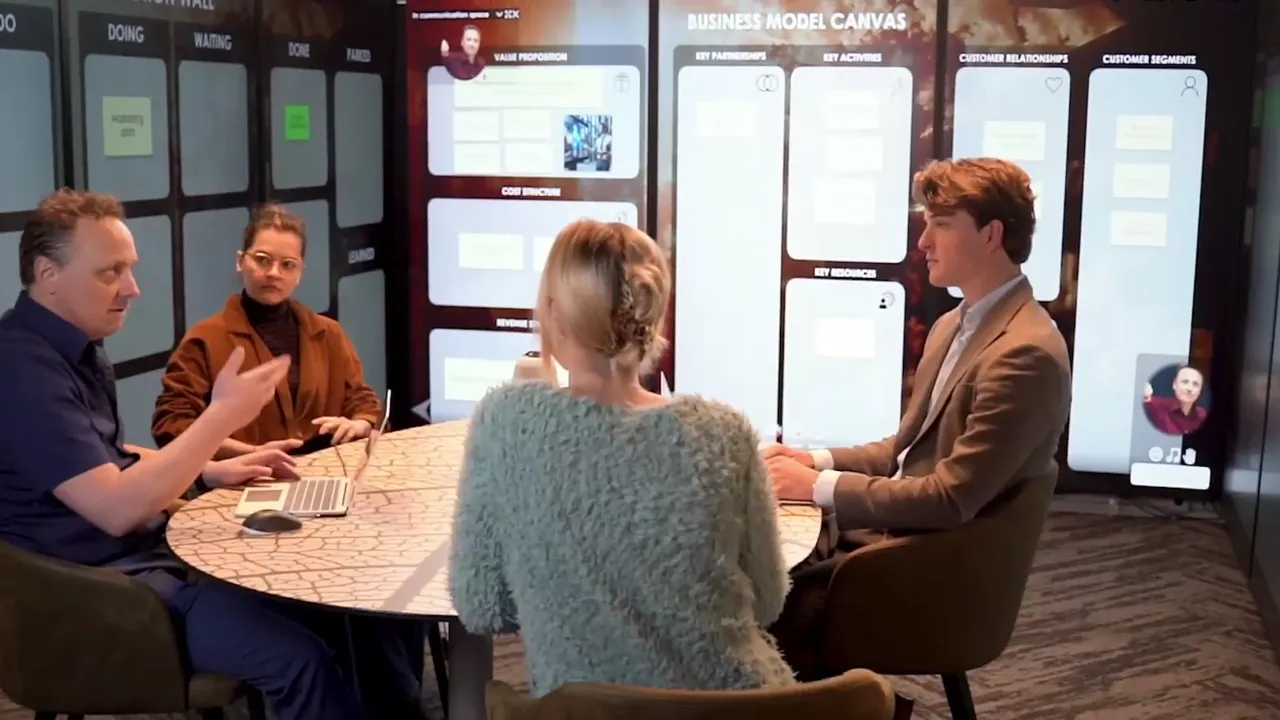
You do not need a separate room. A digital Obeya works on a laptop or on a big screen in the meeting room. Whoever also wants the wall physically around them can scale up later to three or nine screens.
- Pick a ward or a project and five to eight KPIs, each with a target and an owner.
- Attach an action with owner and date to every red KPI.
- Hold a fifteen-minute stand-up in front of the wall for two weeks, in the same room or via a video conversation.
- Only then add plan, risks and decisions.
With the CrewMate, the AI colleague in the Obeya, you can have the first board proposed: you describe what you want to follow, and nothing is on the board before you press Build. The walls explained you will find in The five Obeya walls.
Three things that often go wrong in healthcare
The wall becomes a report for management. If the ward has to fill in the numbers for someone else, it keeps it up until the first busy week. The wall works when the team uses it itself, for its own handover and its own improvements.
Too many numbers hang there. A care organisation measures a lot, and it is tempting to put everything on the wall. Choose the five to eight numbers the team can do something about this period. The rest stays in the reporting where it belongs.
The night shift and the weekends do not see the wall. An Obeya that only exists on working days at nine o’clock reaches part of the team. A digital wall is always there, and whoever misses the stand-up can see what was decided and what changed.
Frequently asked questions
Can an Obeya in a hospital be digital too?
Yes. A digital Obeya works on a laptop, a big screen or spread over three or nine screens. Whoever works at another location or at home sees the same live wall.
Which KPIs do you put on a healthcare Obeya?
The team decides that itself. Commonly chosen topics are waiting time, staffing, cancelled appointments and lead time. Keep it to five to eight KPIs, each with a target and an owner.
May patient data go on the wall?
On a shared wall put counts, lead times and actions, no names of patients. Agree with your privacy officer what may go on the wall in your organisation.
How do you involve the night shift or colleagues at other locations?
Through the same digital wall and the built-in video calling. Guests can join via a link without an account, with a waiting room.
Do we need a special room?
No. Start with a laptop or one big screen. The Syner Suite is there for those who also want the walls around them physically.